Showing posts with label television. Show all posts

Saturday, January 20, 2018

Favorite Cinema of 2017

Scroll down to view my list of 2017 favorites, plus new-to-me old movies and various acting honors (and my least favorite movies, too). Up here I will offer some thoughts on the year's cinema and my selections, instead of individual blurbs for each below.

Everett McGill in Twin Peaks: The Return

You will notice I invoke the word "cinema" this year, instead of "films" or "movies," in this list's title—very French. To me, the word "cinema," in 2018, connotes certain intentions, know-how, and competence—I see it as a qualitative term. Meaning that there are a lot of movies, but not all movies are cinema. Bullshit, you might think this formulation is, but I am seriously invested in the inverse of this line of thinking: Cinema does not have to be a movie—a single, feature-length, moving-image narrative with a theatrical premiere—either. So cinema excludes some, but it also includes, well, what? Television, for one, in addition to media from other platforms (Tim Heidecker's fake, live-streamed murder trial, anyone?). 

The reasons for this are industrial and technological, as well as—I firmly believe—auteurist. With Twin Peaks: The Return—my favorite cinema of 2017, and this decade, by a country mile—it is not controversial to call David Lynch the show's primary author. Yet it would also be a mistake to label Lynch a "showrunner" in the vein of Matthew Weiner or David Chase, who each led a writers' room. Instead, Lynch communicates his artistic sensibility through stylistic and structural means—that he directed every one of The Return's 18 hours is the crucial point of distinction. Even its most classically plot-driven hours betray startling experimental tendencies, from the juxtaposition of tones (see the John Ford-meets-grindhouse brilliance of Mr. C's arm wrestling scene in Part 13) to the commitment to duration (see Bushnell waiting by Cooper's hospital bed in Part 16). The finer details of Lynch and his collaborators' cinematography and especially sound design remained illegible upon Showtime's initial, compressed broadcasts, and only with the Blu-ray and (hopefully) circulation of DCPs will the Twin Peaks theatrical experience, pseudo or not, be realized. Regardless of how one watched it, though, Twin Peaks: The Return impressed many, and frustrated others, with its unique storytelling architecture, finding ample time for dead ends, cosmic jokes, and sequences of wordless passage. If much of The Return's acting and visual style is utterly alien to the medium of television, its structure is slightly more familiar, making its departures from editing norms intriguingly, productively uncanny.

In some of the year's other notable cinema, bold editing choices transformed countless hours of footage into art. In Faces Places, Agnès Varda's associative match cuts enrich a travelogue into a personal work of deep yet spontaneous reflection. In the year's best documentary, and my favorite 2017 "film" proper, Ex Libris, Frederick Wiseman organizes board meetings, lectures, and other dry bits of footage into the rarest kind of political art: one contingent on reality, made from bottom-up. With Song to Song, Terrence Malick—at this stage, American cinema's most acquired taste—spans emotional extremes through quick cutting. In HBO's Big Little Lies, Jean-Marc Vallée does much of the same, playing his characters (who are brilliantly performed and staged) off one another while also diving deep into their individual head spaces. 

An ingenious combination of restricted narration and accumulation elevate Marjorie Prime and The Unknown Girl into two of the most paralyzing, emotional works I have ever seen. Staying Vertical, meanwhile, spirals ever closer to some intimidating state of nature through provocative yet grounded leaps of logic and Guiraudie's signature depiction of fluid sexuality at odds with assumed identity. Asghar Farhadi's The Salesman has the weight and irony of Greek tragedy, while A Quiet Passion, Terence Davies's labored yet exquisitely textured biopic of Emily Dickinson, reconciles a boisterous wit with a terrified and repressed homebody. Alexander Payne's Downsizing, also flawed, nevertheless presents American cinema's most detailed and honest story of class aspiration in ages; a work of supreme structural integrity, it slyly ties moments of uplift to corporate rhetoric. On the other hand, S. Craig Zahler's politically useless Brawl in Cell Block 99 more than gets by on its stoic and physical performances (above all, a stellar Vince Vaughn), ever-putrefying production design, and unfashionably measured pacing.

The Human Surge
The titles above I more or less expected to like—I came in with goodwill for their auteurs. Two new-to-me international figures left a strong first impression: Anocha Suwichakornpong, from Thailand, and Eduardo Williams, from Argentina, both made avant-garde, class-conscious narrative features with By the Time It Gets Dark and The Human Surge, respectively. With its three distinct acts, distinguished by continent and camera format (Super 16 for Buenos Aires, digital filmed off monitor with Super 16 for Mozambique, RED for Philippines), The Human Surge left a mark, as an especially virtuosic and enigmatic rethinking of "slow cinema" conventions.

Call Me By Your Name surprised me more than perhaps any film on this list. Luca Guadagnino's style is a bit impersonal, and he indulges in some stylistic tics that irritate: namely, three Sufjan Stevens needle drops that feel precious and telegraph too much (though further queering Sufjan is welcome in itself). But where it counts, Guadagnino, screenwriter James Ivory and the cast cut deep. The "countdown to midnight" sequence is particularly masterful—sparely designed and digressive, its evocation of hunger elicits a most unusual and effective suspense. Michael Stuhlbarg's monologue at the end is also as good as you might have heard, the rare full-stop speech that activates tacit intellectual and emotional through lines instead of closing them off. It's a comfy, fairly idle gay love story, which is itself also welcome, but the allusions to antiquity and expansive emotional register place the film's accomplishments within the finer trends of Italian narrative art (i.e., di Lampedusa's novella The Professor and the Siren, a recent discovery of mine).

If we are still discussing pleasant surprises, let me also plug Taika Waititi's Thor: Ragnarok, the first Marvel Cinematic Universe movie to be included on my year-end list. Its narrative economy captured my attention, but my main reason for inclusion is quite base: I simply found it very funny. The three last movies I have yet to mentionGood Time, Phantom Thread, and The Son of Joseph—also made me laugh, but I ultimately found them moving thanks to their wholly committed performance styles and gorgeous music.

My thanks if you have read to this point; see below for my list, whose selections by now should come as no surprise. Like last year, I am copying Dan Sallitt's color-coded list format, which ranks films in descending order of red, orange, green, blue, and purple. (Red is an exceedingly rare designation for me.) And, finally, a big asterisk: 2016 festival premieres Sieranevada (Cristi Puiu, Romania) and Yourself and Yours (Hong Sang-soo, South Korea) never received US theatrical release—a minor crime in a year of major ones. If they did, they would easily be included in my Top 5 below.

Geena Davis, Jon Hamm, and Lois Smith in Marjorie Prime


Favorite Cinema of 2017 (NYC One-Week Theatrical or Television)
1. TWIN PEAKS: THE RETURN (David Lynch, USA)
2. EX LIBRIS: NEW YORK PUBLIC LIBRARY (Frederick Wiseman, USA)
3. MARJORIE PRIME (Michael Almereyda, USA)
4. STAYING VERTICAL (Alain Guiraudie, France)
5. THE UNKNOWN GIRL (Jean-Pierre and Luc Dardenne, Belgium)
6. SONG TO SONG (Terrence Malick, USA)
7. BIG LITTLE LIES (Jean-Marc Vallée, USA)
8. THE HUMAN SURGE (Eduardo Williams, Argentina)
9. CALL ME BY YOUR NAME (Luca Guadagnino, Italy/USA)
10. DOWNSIZING (Alexander Payne, USA)
11. BRAWL IN CELL BLOCK 99 (S. Craig Zahler, USA)
12. A QUIET PASSION (Terence Davies, UK)
13. GOOD TIME (Ben Safdie & Josh Safdie, USA)
14. PHANTOM THREAD (Paul Thomas Anderson, USA)
15. THE SALESMAN (Asghar Farhadi, Iran)
16. THOR: RAGNAROK (Taika Waititi, USA) 
17. THE SON OF JOSEPH (Eugène Green, France/Belgium)
18. BY THE TIME IT GETS DARK (Anocha Suwichakornpong, Thailand)
19. FACES PLACES (Agnès Varda & JR, France) 

On Netflix: Staying Vertical, The Unknown Girl, The Son of Joseph
On Amazon Prime: Marjorie Prime, Song to Song, A Quiet Passion, Brawl in Cell Block 99, The Salesman
On Fandor: The Human Surge
On iTunes: By the Time It Gets Dark
On HBO and Showtime, respectively: Big Little Lies and Twin Peaks: The Return

Honorable Mentions: Thirst Street (Silver), Hermia & Helena (Piñiero), Wormwood (Morris), Person to Person (Defa), Logan Lucky (Soderbergh)

Favorite Short Film: Spiral Jetty (Ricky D'Ambrose)

Favorite Stand-Up Special: Norm Macdonald: Hitler’s Dog, Gossip & Trickery (On Netflix)

Three Movies I Expected to Hate But Find Myself, For Reasons I Still Don't Understand, Quite Taken With: A Ghost Story (Lowery), Kékszakállú (Solnicki), Transformers: The Last Knight (Bay)


Still Ambivalent About: The Lost City of Z (Gray), Wonderstruck (Haynes), Nocturama (Bonello)


Did Not Take To: Lady Bird, Get Out, Coco, The Killing of a Sacred Deer, Mudbound,

The Post

Seriously?: The Shape of Water, Darkest Hour, Battle of the Sexes

Unambiguous Dreck I Saw for Whatever Reason: Underworld: Blood Wars, Power Rangers, Kingsman: The Golden Circle 

More Ambitious Disasters (aka Least Favorite): mother!; Wind River; Three Billboards Outside Ebbing, Missouri; War of the Planet of the Apes; Baby Driver; All the Money in the World 

***
Adèle Haenel and Olivier Bonnaud in The Unknown Girl
Favorite Lead Performances:
  • Adèle Haenel, The Unknown Girl 
  • Nicole Kidman and Reese Witherspoon, Big Little Lies
  • Kyle MacLachlan, Twin Peaks: The Return 
  • Vince Vaughn, Brawl in Cell Block 99
  • Lois Smith, Marjorie Prime 
  • Timothée Chalamet, Call Me By Your Name
  • Cynthia Nixon, A Quiet Passion 
  • Daniel Day-Lewis and Vicky Krieps, Phantom Thread 
  • Peter Saarsgard, Wormwood 
  • Robert Pattinson, Good Time
  • Lindsay Burdge, Thirst Street 
  • Kim Min-hee, On the Beach at Night Alone 
  • Haley Lu Richardson, Columbus
Cynthia Nixon and Joanna Bacon in A Quiet Passion
Favorite Supporting Performances:  
  • Naomi Watts, Miguel Ferrer, Sheryl Lee, Amy Shiels, Robert Forster, Laura Dern, Matthew Lillard, Dana Ashbrook, Jim Belushi, and Catherine Coulson, Twin Peaks: The Return 
  • Tim Robbins and Geena Davis, Marjorie Prime 
  • Michael Stuhlbarg, Call Me By Your Name
  • Jennifer Ehle and Joanna Bacon, A Quiet Passion 
  • Alexander Skarsgård, Robin Weigert, and Jeffrey Nordling, Big Little Lies 
  • Damien Bonnard, Thirst Street (also excellent as the lead in Staying Vertical)
  • Willem Dafoe, The Florida Project
  • Buddy Duress and Taliah Webster, Good Time 
  • Lesley Manville, Phantom Thread 
  • Hong Chau and Christoph Waltz, Downsizing 
  • Tiffany Haddish, Girls Trip
  • Jeff Goldblum, Thor: Ragnarok
  • Lakeith Stanfield, War Machine 
  • Mary Lee Kennedy, Ex Libris 
  • Bene Coopersmith, Person to Person 
  • Betty Gabriel, Get Out
  • Patti Smith and Lykke Li, Song to Song 
  • Fabrice Luchini, Slack Bay
***
http://metrograph.com/uploads/films/Angel-1492898785-726x388.JPG
Marlene Dietrich in Angel (1937)

15 New-t0-Me Favorites
Older movies I saw for the first time in 2017, limited to one per director. For 100 old movies I loved, see this ridiculous list on Letterboxd.

1. Angel (1937, Ernst Lubitsch, USA)
2. Daisy Kenyon (1947, Otto Preminger, USA)
3. Claire's Knee (1970, Éric Rohmer, France)
4. Le Trou (1960, Jacques Becker, France)
5. *Corpus Callosum (2002, Michael Snow, Canada)
6. The Devil Is a Woman (1935, Josef von Sternberg, USA)
7. The Last Detail (1973, Hal Ashby, USA)
8. Ivan the Terrible: Parts I and II (1944 & 1958, Sergei Eisenstein, USSR)
9. The Gleaners & I (2000, Agnès Varda, France)
10. The Chronicle of Anna Magdalena Bach (1968, Straub-Huillet, West Germany)
11. Lancelot du Lac (1974, Robert Bresson, France)
12. To Sleep With Anger (1990, Charles Burnett, USA)
13. Black Narcissus (1947, Powell & Pressburger, UK)
14. Remember My Name (1978, Alan Rudolph, USA)
15. Margaret (2011, Kenneth Lonergan, USA)

***

And for the record: I watched 457 movies last year, the majority of them old movies. (My viewing diary, with ratings, can be viewed here.) Looking ahead, the one 2018 release I saw ahead of time was Paul Schrader's First Reformed, starring Ethan Hawke. It was by far my favorite of the Telluride Film Festival, documentary-like in its cataloging of current political and economic outrages, with an ultimate metaphysical turn that knocked me out. Look for it here next year (this year?).

Wednesday, April 22, 2015

So Expert, Much Obscure, Wow.

Sometimes comedy hits so close to home it feels like horror. I was a fidgety wreck at Cinemapolis watching one scene in Noah Baumbach’s While We’re Young, in which Josh (Ben Stiller) pitches his six-and-a-half-hour political documentary to a hedge fund bro. Trapped in close-up, Josh botches it, sputtering out undergrad filler (“prison-industrial complex,” “power structures in the global economy,” etc.) before closing with a Hail Mary to the heartland (“It’s really about America.”). The investor, bored as hell, asks, “So … what’s it about?” The horror of incoherence, at your ideas and the words you choose to share them with, is one I have felt many a time at home and at Cornell.
The unspoken reality in this movie is that Josh is a mediocre thinker and a lazy filmmaker, still stuck in that arrogant film student mode where the burden is all on the audience to comprehend the brilliance of your pièce de résistance. His documentary is boring (its footage is mostly of a renowned but colorless academic espousing his wide-ranging theory, in front of bookshelves or at an underlit dinner table), and it’s boring because Josh has no mastery of the rhetorical tools of filmmaking — like camera placement, sound or editing — that would involve the viewer, no matter how well-read he or she is, to care about the big issues his film tackles. Baumbach, on the other hand, is a subtle enough filmmaker to disclose Josh’s mediocrity without outright stating it, and one of the funniest, and trickiest, aspects of the film is how everyone lectures about the problems they see around them while remaining oblivious to their own. Can you relate?
Incoherence and obliviousness, together, make a distinctly modern comedic pair. Baumbach is not the first to venture into this subgenre of “cringe comedy,” as the Internet calls it, but he does not have a great deal of predecessors either. Of course we have all seen an intellectual caricatured as removed, dainty or impotent in an older film, book or TV show, but the manner in which Baumbach and Stiller render Josh’s esoteric babble engages more ongoing questions, like pretentiousness and privilege. In sustained, awkward close-up, Josh gives himself more than enough rope to hang any prospect of funding, and the discomfort we feel while watching him is sympathetic, if not empathetic, because words have, presumably, failed us all before. At the same time, Josh can spout this pseudo-intellectual nonsense in part due to his white male/Blue Steel privilege, which gave him an unearned soapbox long ago. He should really be trying harder, but still, damn, is he human.
Every thinker fears incoherence. You stumble upon an idea you think is novel, but then you must secure the argument, with the innumerable steps involved, in order to share it with the world. Otherwise your thought is just an abstract glob of noise. (I should know: I’m revising an honor’s thesis at the moment.)
“Noise-shaped air,” on the other hand, is a perfect phrase from the fourth season premiere of Armando Ianucci’s HBO comedy Veep, and it is used to describe the euphonic, fill-in-the-blank insincerity of a speech President Selina Meyer shares before Congress. Veep explores the other extreme of nonsense language — the political sermon — and how inane it sounds when spoken by someone like Selina, a woman with a preternatural gift for inventive vulgarity. I hope to one day buy a leather-bound book of her and the rest of the cast’s putdowns, because they are what make Veep the funniest show right now, but Selina’s facility with disingenuous but nonetheless effective public oratory elevates the show to conscious, critical heights. In the premiere, she riffs off a teleprompter glitch, which spells her presidential ambitions with the placeholder text left from earlier brainstorming: “FUTURE WHATEVER.” With conviction in herself and the drivel she is about to say, she sells worthless platitudes (“Whatever we have in store cannot be unknown. But given time, it can be understood. The past was once the future … ”) and her esteemed colleagues greet her noise-shaped air with rapturous applause.
In “The Universe,” one of their most popular sketches, Tim and Eric, from Adult Swim, make fun of a kind of language in between half-baked academic-speak and hollow, wowing rhetoric. Tim Heidecker, squeezed into a black turtleneck, talks about the wonders of the universe as intentionally crappy video effects whiz around him. “Picture a hot dog bun,” he says, as a hot dog bun fades on and off the screen. “And throw all the stars, the hundreds of stars, that there are in the universe into a … into a bag, and put the universe into a bag, and you, all of a sudden, they become, um … ” His face crumples into a pudgy frown as his tortured metaphor escapes him. I laugh every single time I see it.
Tim and Eric, premier parodists of white male pastiness, find funny the way self-appointed experts attempt to streamline their ideas, particularly when in extreme close-up. They share their so-called research with can-do cheer, living up to the democratic mission of popular science when they turn to metaphor or when Eric Wareheim says, “And us humans can’t even fathom the concept of that kind of time because it’s really really really really really really really really fun!”
But ultimately, Tim and Eric seem to say, incoherence is inherent to any discipline, if it truly is a discipline. True intellectual work requires logic, evidence and manageable innovation, yes, but it’s unlikely the casual reader can just walk in and comprehend a field written by experts. Communicating those big, important ideas should be done in a respectable way, without off-color humor … which is where Tim and Eric, Noah Baumbach and Armando Ianucci come in.
This article was written for The Cornell Daily Sun.

Tuesday, April 7, 2015

Netflix State of Mind

The smart money these days is on Netflix, as both a growing, deep-pocketed agent in the television and movie industry and an attractive new model for how this entertainment can and will be consumed. What started as a mail-order service for movies and some television shows on DVD is now a primarily digital venue for streaming some of the most popular television. It offers movies too, of course, but as far as their quality, The Onion said it best last year with the headline, “Netflix Instant Thinking About Adding Good Movie.” Consider the tendency for movies, especially old ones, to just vanish from the service as TV new and old, from House of Cards to Friends, colonizes the most valuable real estate on its homepage, and we can conclude that Netflix has its own smart money on television rather than movies.
That’s an image Netflix is working to change. This fall, Netflix plans to premiere AAA films like Crouching Tiger, Hidden Dragon II and Cary Fukunaga’s war drama Beasts of No Nation the same day they open in select theaters. Chances are you will know full well that Beasts of No Nation is available to stream if you load Netflix around the time of its debut. It’s likely that it, like this year’s Oscar-nominated documentary Virunga, will have a prominent “Netflix Original” logo over its home page banner ad, or some other graphic claim to ownership that can be easily, imperceptibly mistaken for authorship.
But Netflix is not making Beasts of No Nation. Fukunaga has written and directed the film via Participant Media and Red Crown Productions. Netflix bought the rights for day-and-date streaming, but it has no more claim to authoring the film or the Crouching Tiger sequel or Virunga than Fox Searchlight Pictures has for The Grand Budapest Hotel or The Tree of Life, both of which it distributed.
Do you refer to The Grand Budapest Hotel as Wes Anderson’s film, and The Tree of Life as Terrence Malick’s? I do, even if I still wish to stress that Ralph Fiennes and production designer Adam Stockhausen contributed much to the first film, as Jessica Chastain and Director of Photography Emmanuel Lubezki did to the second. But as a cinephile and film student, I prescribe to the auteur theory, which holds the director as the primary author of any given film (even, crucially, the supposed trash). I would gather many people passionate about movies, whether or not they call themselves “cinephiles” (even I hear that word and think “doesn’t get much sun”), prescribe to a general belief in the auteur theory. The Oscars reinforce it — since 1990, 19 of 25 Best Picture winners also claimed Best Director — and the living legend status of someone like Martin Scorsese shows that we recognize and value the voice behind the camera, especially when it’s as open to caricature as his.
For the longest time, the auteur theory has evaded television. Showrunners like Mad Men’s Matt Weiner claim authorial primacy, with their dual head writer and executive producer credits, though premium networks like HBO and Cinemax have lately challenged that notion by hiring distinctive directors like Fukunaga and Steven Soderbergh for full seasons of True Detective and The Knick, respectively. Networks also retain greater visibility than movie studios because they have commercials, watermarks and password-protected streaming platforms to burn into your brain that, hey, this is an AMC (or NBC or HBO) show. Studios get a trumpet fanfare or roaring lion at the beginning, but they all have to share the same theaters, which have their own pre-movie promos to blast their brands and coax you into buying $8.95 tubs of popcorn. Both studios and theaters, however, tend to shut up once the lights dim and let the movie just be its own immersive thing.
Netflix has capitalized on its unprecedented hybrid status — part viewing platform, part big-money financier, part library — to disrupt these rules. But does it fulfill all those roles satisfactorily, or place too much emphasis on one over the others? As a platform, Netflix’s image quality has improved alongside our wireless routers, so there’s little room to complain there. But why have Netflix’s recent spectacles of checkbook-signing been accompanied by a remarkably inconsistent, waning library? Is all this money really going to Adam Sandler and not to securing Woody Allen’s filmography for more than a few months at a time, to say nothing of classics and hidden gems made before 1980?
Regardless of who “made” a streaming TV show or movie, we watch it “on Netflix.” The move away from physical media, as sad as this Blu-ray fanatic may be to admit it, has created a dependency on streaming platforms for both content and the range and history of that content. Netflix being the most powerful of these platforms, it has grown disinterested with history, instead favoring its capacity to shape the future. Ironically, that future resembles the past, the time when a producer like David O. Selznick claimed authorship behind films like Gone With the Wind and Rebecca, films he didn’t direct. But Selznick was so involved in the movie-making process that he can at least claim credit for one of those two (it’s the one not directed by Hitchcock), while Netflix only chooses and bankrolls original properties and has no hand in their actual production.
As we move through this Golden Age of Digital Content we should be able to recall who is really making it. Netflix does not make it so easy, as it zooms out to wave an arm at its other tantalizing offerings once those pesky credits roll. If you click on the director or star of any given film, it redirects you to DVD.Netflix.com, which is blockier and often useless, given how few filmographies are fully available. Given that Netflix is here to stay, that paucity needs to change if the industry wants its backlog to be viewed legally whatsoever. More than that, however, shining a light on the true authors behind these films directs viewers to engage not just with a single movie but with a varied filmography, epochal movement or entire medium. Auteurists may be an obsessive, idiosyncratic bunch, but our gift for disposing income knows no bounds.
This article was written for The Cornell Daily Sun.

Wednesday, February 12, 2014

A Case for Movies, and Lots of Them

“‘Is TV better than movies?’ is a worthless question. ‘How is TV better than movies?’ can be a fascinating one.”

That tweet, from Philadelphia-based film critic Samuel Adams, has stuck with me since I first read it last November. Adams poses a really potent hypothetical and passes it onto any Twitter-addicted writer willing to elaborate. I knew then that said elaboration would make for a good column, but I realize now that the more pressing argument lies on the other side: How are movies better than TV?

Almost everyone I know spends more time watching, and arguing about, television than they do with movies, and some general assumption has settled in that TV is, in fact, objectively better than film. Like Adams, I do not believe that verdict, or its inverse, holds any water. Yet I do believe that many gloss over the beautiful qualities inherent to the film medium in exchange for the more addictive, long-form pleasures of television. Bearing witness to the carefully calibrated, 47-hour arc of Breaking Bad feels awesome and even transformative, but investing your time into dozens of films over that same span of time can provide even more mind-altering moments and, most crucially, a wider breadth of experience.

Nine times out of ten, movies look more interesting than television. Naturally, exceptions abound — Boardwalk Empire is stunning, while, say, Warm Bodies is not at all — but stick to the giant pool of quality films, old and new, out there and you will see not just tangible things but inner thoughts, biases, desires and so forth. What TV show could scratch all dialogue for its first 30 minutes to deliver a lucid, aching portrait of loneliness and environmental issues, as Wall-E does? Or stay within a man or woman’s unstable mind and depict their psychoses on screen, as 8 ½ and Repulsion do? Or try to visualize the grace of God, as The Tree of Life does? I mean, does anything look prettier than In the Mood for Love or Pacific Rim? All these films look dazzling, and many demand attention be paid to their visuals even more than their story. Unlike most good TV, good movies teach you how to watch them as they go, and that is a fun, thrilling thing. 

Because movies are single, one-unit experiences to be absorbed in one sitting, you can cover decades of film history in the same time it takesDexter to disappoint you over its last four seasons. The abundance of time TV requires means that the focus remains relentlessly on the present, on catching up and binging on the hottest new thing. Acquainting yourself with the various Golden Ages of TV, as The AV Club’s TV critic-historian Todd VanDerWerff gratefully has, takes more time than covering the greatest hits of Tarkovsky, Murnau, Denis, Iranian cinema, queer cinema, ’60s counterculture documentaries or whatever niche you may take a liking to. In between your fourth and fifth time watching The Lego Movie, you can easily catch an old ’50s noir or some mid-’00s War on Terror doc serving a life sentence on your Netflix queue. If you are interested in World War II, ignore The Monuments Men and actually watch a movie made during the war. You remember how your high school librarian always harped on and on about how primary sources are better than secondary sources? That.

The cost of television production means that some talented people, like Louis C.K., get handed a nice chunk of change to do anything with, but it also means that whole swaths of the population go unnoticed. The reason HBO’s Girls holds so much clout is because it is one of the only shows featuring a predominantly female ensemble. It must represent women, as a whole, in addition to letting these specific, affluent and meandering female characters do their thing. Half the time, I find Girls fresh and perceptive; the rest of the time I can’t stand it. Of course, I want to see female characters on TV: I want to see more, I want other options! Orange Is the New Black does it right, but look to independent film and from last year alone you will find Frances Ha, Mother of George, Enough Said, Stories We Tell, Gloria, Blue Is the Warmest Color and many more movies with strong female characters. No one of these shoulders the weight of half the population, which means fewer think pieces and a little more sanity in critical discourse.

Television draws us in because it builds slowly over time. The one lie we tell ourselves when opting for TV over movies is that this 30 or 60-minute episode is all I will watch, and a movie, after all, is longer than that. Of course, you watch another episode, or two, or more, and the time argument becomes irrelevant. The scope of styles you can unravel, sights you can see, lives you can live in cinema is staggering, and each of these vessels takes but a couple hours to come and go. Watching movies, and lots of them, helps to discern personal taste — what you like or don’t like. But film’s greatest power has nothing to do with criticism; rather, it concerns empathy: For a brief fraction of your life, someone else’s pours forth from a brilliant screen, flows over the heads of friends and strangers alike and washes over you.

This article was written for The Cornell Daily Sun and can be viewed at its original location here.

Monday, October 7, 2013

Breaking Bad's Top 10 Episodes

*Co-written with one of my editors at The Sun, Sam Bromer, whose excellent work is designated by an asterisk*

Well, we’ve made it one week so far, and, from the looks of it, we’re going to be just fine in a world without more Breaking Bad. That being said, The Sun would like to offer one final feature on what pretty much everyone has canonized as one of the greatest television shows of all time. Breaking Bad was stellar from start to finish, but, like any show of this caliber, there were some episodes that approached something close to perfection. Below, you can check out the 10 episodes we ranked above the rest. It’s an impossible task that will piss off fans no matter what (“Where’s ‘One Minute’?” ‘Felina’?!), yet we hope you’ll revisit these episodes when you have some free time on your hands or, better yet, when you don’t.

1. Phoenix (Season 2, Episode 12)
Our number one pick does not boast the kickass firepower of “Face Off” nor the perfect dramatic unity of “Fly” or “4 Days Out.” Indeed, the one where Jane dies is very typical, in action and narrative structure. What it does do better than any other episode, however, and through the most moving, startling ways, is come to grips with what makes Walt tick. From Walt beaming as he shows newborn Holly the stacks of cash hidden in the garage to his look of wounded pride when Walter Jr. posts a charity site for his father’s cancer, money — for, and within, the family — appears to be Walt’s motivating factor. But things complicate when Jesse and his girlfriend Jane blackmail Walt for Jesse’s cut. Walt standing over Jane’s asphyxiating body, allowing her to die, is horrible enough, yet it arrives just moments after, by mere chance, he runs into Jane’s father at a bar, where they talk about the difficulties of “family” and how “You can’t give up on them.” Money sets the pieces in place while one man’s selfish need for control assumes the truest power. “Phoenix” is the turning point of the series, as well as a perfect microcosm of all Vince Gilligan was going for. And it is devastating.

2. Ozymandias (Season 5, Episode 14)*
No, the episode named by dozens of critics, thousands of IMDB users and even Vince Gilligan himself as the best episode of the series is not our number one pick. But that does not mean it is unworthy of the heap of praise it has received: “Ozymandias” is Breaking Bad at its most thrilling, its most powerful — and its most sickening. From the moment Walt’s “shattered visage lies, half-sunk” in the sands of To’hajiilee, it is clear he, and by extension, we, have turned a dark corner; as the AV Club’s Donna Bowman succinctly points out, the Spaghetti Western vibe of Breaking Bad’s highly stylized previous episode devolves into a veritable “horror show.”
Unsurprisingly, Bryan Cranston is at his absolute best in “Ozymandias.” As the empire he has built is reduced to rubble, with nothing remaining but a solitary barrel of cash, Cranston earns his accolades, presenting both the frantic desperation of a man trying to salvage something from nothing and the chaos of two personalities clashing into one. Even as he rats out his former partner, kidnaps his own daughter and threatens his wife over the phone (albeit to ostensibly help her), it is disconcertingly difficult not to feel sympathy for Walter.
“Ozymandias” works breathtakingly well on all levels; as a character study, as a thrilling climax and as a perfect nightmare scenario, where our greatest fears for these characters, spurred from the earliest moments of this series, become a reality.

 3. 4 Days Out (Season 2, Episode 9)
This bottle episode (an episode filmed on mostly one set and a limited budget) is impossible not to love. After discovering what he thinks is a ghastly tumor on his x-ray, Walt recruits Jesse to cook one last batch of meth, far out in the boonies. What starts as brilliant comedy — Jesse lectures Walt on artist Georgia O’Keeffe: “She does these vagina pictures” — nosedives into survivalist horror, when the RV’s battery explodes and Jesse pitches all their water on its fire. Walt nearly gives up hope and accepts death, which is right around the corner for him anyway. It takes Jesse’s persistence to shake Walt out of it, plus a great line where Jesse declares with confidence that “wire” is a chemical element. Things get back onto track … until Walt receives his x-ray results back: He’s clear, in remission. After hugging and crying with his family, Walt retreats to the bathroom, where he beats a paper towel dispenser to shit. He already accepted death and evil in his life, and without one, he’s destined to succumb to the other.

4. Fly (Season 3, Episode 10)*
Thank God for budget constraints. Like “4 Days Out,” “Fly,” the acclaimed and largely self-contained masterpiece from Breaking Bad’s third season is a bottle episode. On a functional level, its plot adds little to the overall story arc, and if you’re looking for tense gunfights or nursing home explosions, look elsewhere. Yet, as a singular allegory for Jesse and Walt’s mercurial relationship, a darkly comic exploration of the forces at work in Breaking Bad’s universe, “Fly” is unmatched. In the episode, Walt, suffering from insomnia and paranoia, becomes fixated on finding and killing a fly that is “contaminating” the lab.  At the heart of this tale, whose sensibility lies somewhere between the obsession of Moby Dick and and the absurdist slapstick of Waiting for Godot, is a monologue delivered by Walt in another of Cranston’s finest hours. “My God,” he exclaims, “the universe is random, it’s not inevitable, it’s simple chaos. It’s subatomic particles in endless, aimless collision. That’s what science teaches us, but what does this say? What is it telling us that the very night that this man’s daughter dies, it’s me who is having a drink with him? I mean, how could that be random?” Unable to resolve the existence of justice in a disordered universe, he gives up trying. As he defeatedly tells Jesse just before the episode’s close, “It’s all contaminated.”

5. Better Call Saul (Season 2, Episode 8)
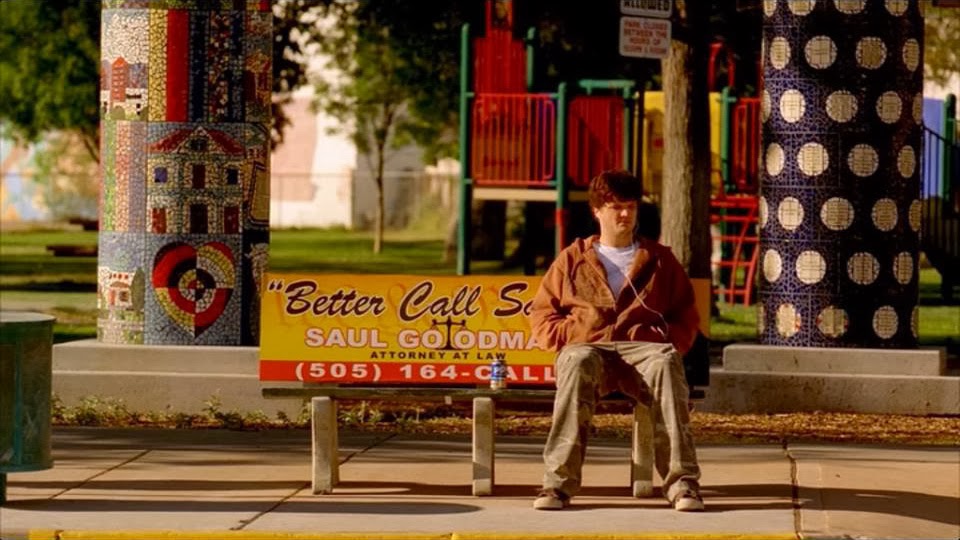
As a sign of the show’s many layers of greatness, Breaking Bad’s funniest episode is also one of its most cinematically ambitious. It opens with a single long shot of a lanky dude coercing Badger into selling him some meth. When that dude turns out to be a DEA agent and the deal a bust, you realize that long shot was probably a camera in a surveillance van across the street. Brilliant! The introduction of everyone’s favorite bus-stop lawyer, Saul Goodman, produces some of the series’ most memorable lines (“Faith and begorrah! A fellow potato eater!”) and leads to a criminal-for-hire taking the fall for Heisenberg — but only after everything goes wrong. It’s as rigorously edited a sequence as any meth-making or prison-shanking montage, and a million times more hilarious.

6. Crawl Space (Season 4, Episode 11)*
A single moment alone justifies this episode’s inclusion on any Top 10 list. In case you can’t remember the iconic moment to which we refer, here’s a refresher: Walter enters the crawl space for which this episode is named, expecting to find the money he needs to escape Gus Fring with the vacuum man. Instead, he finds an empty basement. Panicked, he begs Skylar to explain where the cash has gone, and she tells him, in a tone of measured terror, that she has given it to Ted. Walter, beginning to lose track of his sanity, breaks down. as the camera pans out, framing Walt in a coffin of his own misdeeds, he laughs maniacally. All the while, the sounds of mechanical feedback echo as the only sound in a void. There is only terror — then the credits roll.
Oh, and the rest of the episode works well, too.

7. Madrigal (Season 5, Episode 2)
Better than “Box Cutter”? “Dead Freight”? “Face Off”?! With its cocktail of tones, palettes and character moments, yes, “Madrigal” earns its rank. The cold open delivers a concentrated shot of delirium as a blank-eyed and silent German businessman taste-tests various condiments before committing suicide by automated external defibrillator. As a way to show the scope of Gus’ and Walt’s meth empire, the scene could not be more off-the-wall. From there, you get Jesse’s anguish over his “misplaced” ricin, Lydia’s horrifying pleas to Mike as he holds a gun to her head and Walt’s sickening bedroom abuse of Skyler. Good shows can live off dynamite set pieces and season finales, but only the greatest keep you riveted as the pieces are slowly put into place.

8. Face Off (Season 4, Episode 13)
First off, let us clarify that “Face Off” would be higher if not for the last scene’s Lily of the Valley reveal, which we buy but still consider a stretch. That being said … wow. Gus and Walt’s game of chess ends with a pawn, wheelchair-bound Tio Salamanca, taking out the mighty king. “Ding-BOOM,” read a card tacked onto the writers room’s board months before they wrote this episode, and we are grateful Gilligan and co. pulled all the stops to make it happen — even the ricin gambit, sure. But we most love Uncle Tio’s extended flip-off to the DEA, communicated one letter at a time, in order to lure Gus into Walt’s trap while ensuring he dies without becoming the most dreadful of creatures: a rat.

9. …And the Bag’s in the River (Season 1, Episode 3)*
Classic moments are scattered throughout this early episode, often marked by Breaking Bad aficionados — myself included — as the one that got them fixed on the series. Among these, two deserve “classic status” among the pantheon of great scenes. First, the cold open, where the camera switches off between Walt and Jesse struggling to choke back vomit as they clean the hydrochloric acid-soaked remains of Jesse’s former partner, and a younger Walt discussing the mysterious chemistry of the human body with Gretchen, then a fellow chemistry student. Second, a more simple, but equally powerful, scenario: Walter weighing the pros and cons of killing Krazy-8, a meth dealer who had previously attempted to kill him and Jesse.  The sole pro? “He’ll kill your entire family if you let him go.” In a single scene, Cranston and the writers manage to encapsulate Walter’s constant justification for his actions: he must protect his family, and it is better they than he. As the show goes on, of course, Walt bastardizes this logic, letting, “I did it for family!” justify increasingly heinous actions. In doing so, he becomes the danger.

10. Dead Freight (Season 5, Episode 5)*
Breaking Bad has it all, as the above list has attempted to illustrate. From slapstick humor to mortal terror — and everything in between — the show manages to pay homage to several forms of art while paving a strikingly original path. In “Dead Freight,” Gilligan and Co. take on the caper. In fact, in the vein of the Westerns they so love to reference, the writers have Walter and his team pull off a train robbery. Of course, they do not go in guns blazin’ — though the murder of Drew Sharp provides an exception. No, Walter is smarter than that. In one of the most captivating exploits of the series, they use ingenuity (science, bitch!) to pull off their bold plan. It is a fine example of Bad’s flexibility, and a thoroughly entertaining watch from start to finish.

Honorable Mentions: “Over” (Season 2, Episode 10), “Box Cutter” (Season 4, Episode 1), “Gliding Over All” (Season 5, Episode 8), “Half Measures” (Season 3, Episode 12), “To’hajiilee” (Season 5, Episode 13)

This article was originally written for The Cornell Daily Sun and can be viewed at its original location via this link.

Wednesday, October 2, 2013

Spongebob Hits Rock Bottom

Courtesy of Santi Slade
Spongebob deserves better. In this Age of Taking Television Seriously, no one has a problem writing thesis-length encomiums on The Wire, Mad Men, Deadwood, etc., etc. I’m one of those — just yesterday I threw 1100-plus words at Breaking Bad’s finale, like everyone else. But where’s the love for Spongebob Squarepants? I know it’s a show you probably watched before your brain, like, worked, but creator Stephen Hillenburg is due for a retrospective or two. Worthy of the singular, self-contained TV episode pantheon that includes Bad’s “Fly,” The Sopranos’ “College” and Lost's “The Constant” is the Nickelodeon cartoon’s finest 12 minutes: “Rock Bottom.” Here is a cartoon that explores existentialism, race, quantum theory and linguistics — seriously.

For a show so rife with irreverent joy, I recall the dread that befell me watching this episode as a kid. When Patrick sees the sign, “You Are Now Leaving Bikini Bottom” he asks, as more than a few of us would, “Spongebob, where is ‘Leaving Bikini Bottom?’” For me, drifting away from home, without a plan or supervision, was a terrifying prospect. Patrick does not even register what the sign means, instead thinking it’s another part of his hometown. When they do hit Rock Bottom, a benthic community populated by anglerfish and eels with funny accents, they remark how different everything seems. Even the sand is different — it says so itself! I don’t think I’m stretching things when I say that, in “Rock Bottom,” Spongebob and Patrick leave the suburbs and find themselves in the ghetto.

And for a little sponge and a clueless starfish, the ghetto is a scary place. With their dinky, prophylactic-looking glove hats (what you discover watching cartoons when you’re older …), Spongebob and Patrick stay close to the bus stop where they arrived yet still fall victim to crippling disorientation, culture shock and fear. Spongebob, at least, tries to keep things together as Patrick’s mental state rapidly deteriorates. You should credit the episode’s disciplined writers Paul Tibbitt, Ennio Torresan and David Fain, then, for throwing in a deus ex machina and getting Patrick out of there, on a bus that materializes the second Spongebob leaves his side.

It’s almost as if the world conspires to screw over poor Spongebob, altering the very fabric of time and space to do so. One of the episode’s classic set pieces illustrates an absurdist, catch-22 scenario where Spongebob, hungry after waiting what seems like hours for the bus, discovers, across the road, a “Kandy” machine. Just a single vending machine, hovering there like a mirage or a tempting Siren. After looking down both stretches of the desolate, far-reaching road, he bolts over, checking the road every step, to buy a “kelp nougat crunch” bar. The second he reaches the machine, however, the bus pulls up, stops for a millisecond and leaves.  Spongebob discovers the impossibility of boarding when he reaches into the machine’s tray for a candy bar the moment a new bus arrives, only to pull his hand back out of the tray and watch the bus go backwards. In, out, in, out, forward, backward, forward, backward, like a DJ scratching a record. Spongebob reaches in to tap the candy bar and the bus’s engine purrs. It’s either the candy bar or the bus — or, in actuality, neither. What other children’s cartoon bases its sight gags on the paradoxes of the observer effect and Schrödinger’s cat?

Fed up with his no-win situation, Spongebob thinks a trip to the bus station will somehow solve his problems. He comes in huffing and puffing, yelling, “I’m first in line, and no one’s going to tell me otherwise!” Except the fish he cuts is a giant, moaning pufferfish. Naturally, he limps his way to spot 329. He can’t even hold on to that number for long once the fish in front of him lays an egg from which three clothed babies pop out, also apparently in need of assistance. When he finally reaches the counter, he modifies his accent, adding the requisite “pbbt” sound in between syllables when asking for the next bus. “The next bus leaves in *pbbt* five seconds,” the attendant deadpans. Tired and emasculated, Spongebob cannot find his way home even when conforming to this strange language.

Spongebob’s display of bravado does not hold up when the lights go out, plunging him into what he calls “advanced darkness.” His plan to stick out the night in the bus station is obliterated when that colloquial sound (it sounds like farting) echoes through the hall. He walks, runs and finally sprints away before crashing into a wall, when the anglerfish he met earlier greets him with the glove balloon he lost. The angler ends up giving Spongebob his ticket out, tying the balloon to his wrist, blowing some air into it and sending the confused sponge attached to it floating back to Bikini Bottom. Spongebob thanks the good Samaritan, “Thank *pbbt* you!” “You’re welcome,” a remarkably boring, accent-less voice replies. After all that uncertainty with language and fear of the dark (make of that word what you wish), Spongebob relies on the kindness of strangers to find his way back. The episode ends on a note of optimism and integration, not irrational terror at “the others” of the world.

Well, sort of. Spongebob does make his way back home, but the moment he arrives, his glove balloon pops. Speeding by in a bus, unable to see him, Patrick hollers, “Don’t worry, Spongebob, I’m coming back for ya!” The unbroken cycle of the Absurd commences once again, and this time without a balloon.

This article was originally written for The Cornell Daily Sun and can be viewed at its original location via this link.