Showing posts with label kubrick. Show all posts

Thursday, November 13, 2014

Interstellar Review

Interstellar
Directed by Christopher Nolan
Released in 2014

It’s odd, hearing Matthew McConaughey talk in space. His is a voice of the earth, American earth — the kind of slow, colloquial drawl to pass the time while watching baseball games, driving past cornfields or losing your mind on HBO.
In Christopher Nolan’s Interstellar, McConaughey’s hero Cooper leaves these icons of Americana (well, two out of three) behind in order to save them. Naturally, Cooper takes that star-spangled sensibility with him through the cosmos, and it’s that from-the-gut-ness, as Stephen Colbert might say, that wins the day, or something like that. Throwing McConaughey and all he stands for into a sci-fi retelling of The Odyssey is a simple but potent concept, one this clumsy and often visually pedestrian movie works hard to undermine. Yet Interstellar drops its sentimental payload with such aplomb that it’s futile to resist it, which makes it, intentionally or not, a pretty thoroughly American movie.
On a remote, dust-ravaged farmhouse in the near future, Cooper lives with his family, or what remains of it: daughter Murph (Mackenzie Foy), son Tom (Timothée Chalamet) and the father of his deceased wife, Donald (John Lithgow). The days of Homo sapiens are numbered due to a disease called “blight” that destroys crops, but the timbre of the earthbound first act is quiet, even calm, as the adults adapt to or just ignore the intensifying hostility of their surroundings in order to provide for their children a comfortable existence.
Murph is daddy’s girl, a restless, red-haired intelligence nurtured by Cooper’s attention and playful humor. The rapport between father and daughter is sweet and just strong enough that their estrangement, once Professor Brand (Michael Caine) recruits Cooper, a former pilot, to lead an expedition through a wormhole adjacent to Saturn in search for hospitable planets, sets the emotional stakes for the rest of the film. With Amelia Brand (Anne Hathaway), the professor’s daughter, Doyle (Wes Bentley), Romilly (David Gyasi) and a sarcastic A.I. system named TARS (Bill Irwin) that uploads the comic relief of HAL 9000 into the shape of The Monolith from 2001: A Space Odyssey, Cooper sets off, determined, of course, to find a new home and return to his own.
Interstellar is as flawed as Hollywood tent-poles come. It’s worth noting that Nolan’s style has long been one of the most compromised in the business, eschewing narrative concision for verbosity at every turn yet resorting to flat, recycled compositions to constrain actors hired to talk and talk and once in awhile act. That he and his brother Jonathan, who co-wrote the screenplay, so waste John Lithgow by sitting him down on a porch to listen to McConaughey spoon-feed purple prose (“We used to look up at the sky and wonder at our place in the stars. Now we just look down and worry about our place in the dirt.”) in static medium shots not once but twice should mandate a budget cut of 90 percent for their next film, with Lithgow and, I don’t know, Sigourney Weaver as leads.
This visual and verbal blandness carries over into space, where the razzle-dazzle you’re paying for sits next to a lot of shots of astronauts sitting around espousing the themes or else questions of their movie. Of the half-dozen people I have spoken to about this, not one has failed to mention Amelia’s speech about how love “transcends time and space,” or mock vomit while doing so. During one of the protracted sequences that cross-cuts between the astronauts quarreling and Cooper’s now grown-up children (more on that in a bit) back home for no purpose other than to remind you how little use the latter have in the plot, I wrote in my notes, “This is bad. How bad?”
Yet since watching Interstellar to its completion and mulling over it quite a bit, I have taken a softer tone. This is not cohesive or exemplary filmmaking, not at all, but a bunch of moments in it land, moments that define Cooper and present him to us without pretense. In an atypically understated scene, we learn that Cooper walks around the cabin listening to sounds of rain, thunder and chirping birds, an ambience that calms Romilly and reminds us of the simple pleasures (and completely unique ecosystems) they are fighting to preserve.
For the stakes here are devastating, are they not? Cooper not only faces the easy possibility of never seeing his children again but also, by exploring planets where time elapses at a slower rate (the relativity physics of which the film attempts to explain many, many times), of seeing them die before him. A parent’s worst nightmare, and Cooper grieves over those lost moments in one of the most affecting scenes in any blockbuster, ever. It’s the rare full stop in a movie that runs for almost three hours and yet always seems to be in a rush, and it cuts through all the talk of multiple dimensions and “quantum data” to get the heart of our heroes’ and Nolan’s endeavor.
For while he has gained a devoted (I’d say too devoted) following for his so-called “heady” themes and tricky narrative structures, Nolan has always been a closet sentimentalist, obsessed with dead family members mainly wives) and wringing these clichés for all the male angst, guilt and mopey faces they are worth. Here, at last, he has made an old-school tearjerker that starkly, painfully illustrates the new-school science of his plot through an intimate family drama that should resonate with just about anyone.
The trouble with Interstellar, then, is that it does not know how simple it is. The tension between inspiring awe and explaining that awe — a tension no doubt enforced by studio executives and the loathsome bunch that judges fiction for its scientific veracity — deflates a fascinating scene in the last act, where Cooper explores some Inception-like impossible architecture and refuses to stop postulating as to its origins. Kubrick, the obvious precedent, let his mysteries just sit there, unnervingly silent, and the legacy of Interstellar will be a short one for wrapping up all its loose ends so neatly and anxiously.
Yet as much as this film wears an unearned intelligence on its sleeve, it is still about a man who is not a thinker but a doer. No matter how much the directing or writing may saddle the purity of that man’s struggle, Cooper’s farm-grown charm carries him through a wormhole and pulls us in with him. Perhaps it’s only fitting that he comes face to face with the secrets of the universe and can hardly contain his excitement, for he holds the instinctive assumption that he must share these stories with his children, in due time.
3 Stars Out of 5
This article was written for The Cornell Daily Sun and can be viewed at its original location here.

Wednesday, November 5, 2014

You're Liking It Wrong

‘Tis the season for best-of-year list-making to once again consume the minds of tastemakers, both actual and wannabe. For us clammy, opinionated few in the Sun arts section, that means a lot of time murmuring, alone, at a shared GoogleDoc spreadsheet, worrying why FlyLo’s “Never Catch Me” is not on every ballot and casting shade at everyone else’s taste through snarky comments and Tim & Eric GIFs.

That explains my experience, at least. Truth is, all this antagonizing comes from a playful place, not from any legitimate, swirling anger directed toward the tastes of my peers. Part of this ease stems from my acceptance, sometime over the last two years, that there is no “Best” anything, especially when decided en masse. Midway through last awards season, when movies become racehorses and cease to be seen as art, New York Times film critic A.O. Scott observed, “Criticism rests on the independence and integrity of the singular.” Words I can live by.

With the power to judge works on a personal level comes the profound yet, in this clickbaitian epoch, devalued responsibility to respect the opinions of others. I know that sounds like a cat poster, but it’s true, and it requires a few more words to unpack. So let me first backtrack and pose a new question: Is it possible to take issue with someone who likes a movie that you do but for totally different, and therefore wrong, reasons?

In short: Yes, you most certainly can, you definitely should and this should not come as a surprise to any of you. One of the more implicit and important lessons to a humanities education comes in the recognition that there are not just other people in the world but other minds, too, all equally vast and treacherous. That is humbling to admit, and crucial to remember until the day you die, but it does not mean we should keep quiet. Every person is a precious flower, yeah yeah, but growth stems from these little intellectual quarrels, when we form an argument addressed at a formidable friend or foe and secretly, unconsciously hope his or her retort is good enough to keep the volley going.

You think The Grand Budapest Hotel is just a barrel of laughs and pastel colors? I’d say you missed a great deal of sadness, fascist metaphor and meta-commentary on the iterability of storytelling. Boyhood is “relatable” and nothing more? I’d say it’s an upsetting depiction of the ways we both change and fail to change, or even retain agency, over time and how our messy lives never fit into neat narrative arcs. Non-Stop and Lucy are trash and thus worthless? Well … you should know where I stand on those two by now.

Of course, no one else shares my takes on every film. Not because mine are right or better than anyone else’s, but because they are influenced by my own subjective experience, which is something I have elaborated on a couple times this semester. I have put in the time to develop what I hope are rigorous and interesting readings of a great deal of films, yet I recognize that these readings coexist with a million different others. Just because I say something specific about, say, the tracking shots in 2001: A Space Odyssey does not cancel out, in my eyes, the validity of an opposing interpretation.

I hope others think I’m “getting at something” or that I’m “right on the money” with my piece on [insert film here], but deep down I know any supposedly perfect review could be countered by a perfectly reasonable alternative written from a different frame of reference. I still own what I believe in, and I will defend my position with fire if required, but I’m not going to lose sleep because one friend or the Tomatometer disagrees. All I have in this world is my taste, which is true only to me no matter how adamantly I believe otherwise, but I’ll do my best to sustain the illusion with a marvelous grace.

This article was written for The Cornell Daily Sun and can be viewed at its original location here

Thursday, September 11, 2014

2001: A Space Odyssey

2001: A Space Odyssey
Directed by Stanley Kubrick
Released in 1968

If you don’t believe in God, you might as well believe in the movies — where you can be God. British critic Raymond Durgnat once said something to that effect, and it’s not hard to parse what he was getting at: All movies, even the bad ones, unfold before an all-seeing crowd of voyeurs, each free to judge characters when they fail and feel responsible for their success. 2001: A Space Odyssey, which will screen at Cornell Cinema tonight and Sunday evening, pitches this thesis into the infinite vastness of space, where the all-seeing viewer does not judge or relate but sees, for the first and possibly only time, through the eyes of God.

That may sound like a brooding, moralistic slog, but the genius and lasting beauty of 2001 is how light it is on its feet. For a famously accurate film that interrogates mankind’s technical progress, from the first bone-as-weapon to the spaceship that realizes our species’ ultimate Manifest Destiny, the action and ideas embedded within play like music, not polemics. Indeed, 2001 transfixes in its use of music, like when Johann Strauss II’s The Blue Danube turns a lengthy spaceship docking into a waltz, or when early hominids shriek at a black alien monolith as the discordant creepiness of György Ligeti’s “Requiem” gets under our skin. These moments are brimming with ideas — think about the spaceship’s lyrical movements compared to the hamster wheel dynamics of the astronauts — but you need not mine for meaning to get the full experience, which is to feel awe at the magnificent and fear at the unknown.

Director Stanley Kubrick, who wrote the script with Arthur C. Clarke, had a thing for symmetry and one-point perspective, so that staring at a corridor or wormhole is to stare down its endlessness. The forced compositions betray a meticulous mind, for one, as well as a perceptive, knowing eye behind all the space politics, antagonistic A.I. systems and otherworldly encounters. When we watch astronauts David Bowman (Keir Dullea) and Frank Poole (Gary Lockwood) navigate their spaceship, we are not looking at human movement so much as automated motion through narrow, fluorescent spaces. There is no room for choice, and thus error, in the ship’s spectacular, streamlined design, and the symmetrical cinematography drives home both the efficacy and inhumanness of this advanced technology.

This explains why Bowman and Poole are utter blanks — anyone who has a bone to pick about the “bad acting” here is missing the point — and HAL 9000, the task-managing supercomputer on board, is genteel, wise and terribly sentient. 2001 doubles as a cautionary tale for how the human brain can only process so much knowledge, and when our species hits that prophetic “singularity,” we will kneel just as the apes at the film’s beginning did before their monolithic master. Perhaps the most novel and inspiring twist in 2001’s plot involves a certain choice (which I will not spoil, if for some reason you are still reading without having seen the movie before) Bowman makes in a dazzling red room. Bowman’s decision exercises tremendous courage and agency, but its protracted, elegiac aftermath may be one of the saddest scenes in American film. How could [insert climactic event] be such a tragedy? 2001 proposes that once humans hit a point in our applied intelligence, we entrust humanity onto technology and forfeit ours in the process.

Kubrick ejects the tension between humans and technology out the thematic airlock once the final act arrives, with its most memorable title, “Jupiter and Beyond the Infinite.” The events that transpire here are unforgettable, for Kubrick and special effects pioneer Douglas Trumbull discard plot in order to depict something approaching the ineffable. It’s odd how some people approach the “Star Gate” sequence as a puzzle, and are thus frustrated how it refrains from spelling out its secrets. It’s not “about” much anything, except perhaps sight itself. This acid-washed spectacle elapses over a wordless 10 minutes, and it’s worth keeping in mind the literal time of Bowman’s journey probably takes an eternity longer. This sequence and the uncanny one after approximate mankind’s final achievements, if we ever reach them, and how we will no longer just be Homo sapiens once we arrive at the other side.


Exploration has always brought with it violence and, to excuse the violence, moral hierarchies. What 2001: A Space Odyssey, an easy pick for the greatest of films, posits is that the arrogance of man sustains only by the limits of our understanding, and that when our brave rocket man clears that final hurdle, be it literal or metaphorical, the rest of us will answer not to death rays but a deafening coo.

This article was written for The Cornell Daily Sun and can be viewed at its original location here.

Tuesday, July 29, 2014

Lucy Review

Lucy
Directed by Luc Besson
Released in 2014

Lucy is an exhilarating liberation from sense — a slender, manicured middle finger to anyone who carped about Gravity’s jetpack physics or reassessed their love for a movie after watching one of those “Everything Wrong With…” videos on YouTube. To say this movie has plot holes or is “so dumb” is to say nothing critical at all; those are platitudes, facts, technical specifications. Watch Lucy on its own terms and enjoy a rare collision of 21st century style and themes with old-school, no-nonsense narrative economy. It moves faster than you can think and it’s all over in — have I mentioned?? — 90 minutes.

Scarlett Johansson is Lucy, a pretty much average, intellectually at least, American studying abroad in Taiwan. When we first meet her she is in the middle of some boring back-and- forth with her boyfriend until — being the scumbag his wiry beard and tinted shades telegraph him to be — he handcuffs a mysterious suitcase to her wrist, for immediate delivery to a Mr. Jang (Choi Min-sik, of Oldboy fame). Jang’s henchmen knock her out, surgically insert the contents of the case — a bag of blue crystallized drug called CPH4 — into her lower tummy and, for added macho awfulness, one of the goons gropes her while she is chained in a dingy room. Since she is a strong female protagonist, she wards him off, but since this is also a screw-the-patriarchy kind of action flick, he retaliates by kicking her in the abdomen. The bag inside her leaks and an animated camera flies through her arteries as blue crystals spill into her bloodstream, lighting up like fireworks and sending her into a convulsive, floating fit. But she survives, and Lucy 2.0 is born.

From this point on, Lucy does not waste a single gesture, glance or step. The drug in her system fuels her brain to reach its untapped potential — to go beyond our brain’s paltry efficiency, which Professor Norman (Morgan Freeman, Hollywood’s go-to for making nonsense sound smart) hypothesizes sits at 10 percent. In the midst of this initial action, director-producer-writer-animorph Luc Besson (Leon: The Professional, The Fifth Element) cross-cuts to Norman lecturing before a rapt university audience (i.e., us) about the possibilities of using 20, 40 and eventually 100 percent of the human brain. Telepathy, extrasensory perception and other powers he admits belong in the realm of science fiction could be tapped into, and sure enough Lucy wields all these and more as she avenges her kidnapping, quarantines the rest of the world’s CPH4 supply and, I don’t know, attains the infinite sum of universal knowledge. References to 2001: A Space Odyssey abound, and rarely does an action film overreach so spectacularly.

Besson throws everything at us with his hypermontage style. Footage of cheetahs stalking prey, laundry machines and dividing cells pop up sporadically for associative, not quite subliminal effect. It’s a bit much, but then so is the whole movie. The leaps of logic — to say nothing of the laws of physics — enhance the film’s kineticism, naturally, and even make sense, thematically. This is a movie about a woman who evolves to attain a divine plane of omniscience, and better she do things impossible, bizarre and batshit crazy and leave us scratching our heads than…not. On Letterboxd, Jake Mulligan writes eloquently, and soberly, of how this is one of the only true “superhero movies” ever made. I’m all on board, and my only annotation is that ludicrous genre fare such as this may be the only proper vehicle for cinematic explorations of divinity: The only way to do it right is for it, in the end, to not fit together so neatly, and better have fun doing so than harden our theater seats into pews.

There are also car chases (note, plural) where coupes screech across asphalt on their sides and taxis catapult with a flick of Lucy’s wrist. But what makes Lucy good cinema and Transformers 4, Michael Bay’s undeniable talents aside, just a headache? Brevity is the soul of wit, and so Besson’s quick cuts keep action scenes short, breathless, lethal. And because of this tactical precision in the editing room, and a relatively conservative (or perhaps unnoticeable) use of special effects, Besson maintains a sense of plausible reality in spite of all the implausible going-ons. You will laugh throughout, and rest assured that is intended.

If I am overrating Lucy at all, it is because I am considering it in the context of Hollywood movies today, and especially their norms for screenwriting. The industry now values the likes of Damon Lindelof, Roberto Orci and Alex Kurtzman, who suffocate any momentum their stories stumble upon with relentless qualifiers, asides and blatant exposition so to keep the plot hole warriors on IMDb at bay. In the end, movies like Prometheus, Mission: Impossible — Ghost Protocol and the new Star Treks are overlong, pedantic and, yes, still rife with all sorts of lapses in character motivation and logical continuity. Action cinema just takes itself so seriously these days.

There’s a moment in Lucy that takes place in an airplane bathroom, and it comes out of nowhere. I love that the movie made no attempt to explain it or incorporate the power she attains until the very end — and even then, only implicitly. This movie is uncut, color-coordinated nonsense  revolving around an ass-kicking heroine, but it’s also a bit more: As the story plows to its end, Lucy gets smarter, kills less (that’s for the boys to keep up, as the futile battle scenes at the end commiserate) and supersedes her physical female form. Godard famously said, “All you need for a movie is a gun and a girl,” to which Lucy agrees, only with some crucial additions.

Three makes a trend, for Scarlett Johansson’s last three projects, outside of those in the contractually-obligated Marvel machine, mark a conscious redefinition of her image. Objectified and fantasized over more than most, she has now played three non-humans in a row with Her, Under the Skin and Lucy. Once the drug takes in this film, she remarks in soulless monotone how she no longer feels fear, pain or desire: “All things human fading away.” Besson fixates on her with many loving close-ups, but for once you feel she has found a director and a project that meets her on her own terms.

Final Verdict:
4 Stars Out of 5

This article was written for The Cornell Daily Sun and can be viewed at its original location here.

Friday, September 28, 2012

The Master Review


The Master
Directed by Paul Thomas Anderson
Released in 2012

“I’m finished” are the final words of director Paul Thomas Anderson’s last picture, There Will Be Blood. It is not a spoiler, for those of you who have yet to see it, because the line drops almost as a non-sequitur when preceded by the momentous climax. Those two words grant a sense of closure to a great, ambitious film — one with an epic yet straightforward narrative. Anderson’s newest work, The Master, has no such neat ends. It is a mammoth: towering and gorgeous, yet uncanny in its thin disconnect from reality. It is a vexing character study that churns over themes of freewill, sexuality and the self. Upon viewing its opening shot of crystal blue water foaming in a WWII battleship’s wake, I thought of Tarkovsky’s 1972 sci-fi classic Solaris and its brewing ocean planet. The Master is a puzzle for those who love capital-f Film.

Known shorthand as the “L. Ron Hubbard Movie,” The Master does indeed base its title character, Lancaster Dodd (Philip Seymour Hoffman), off of the Scientology founder and blasts the groupthink of such a cult. The verbal fireworks between Dodd and a dissenter (Christopher Evan Welch) during Dodd’s introspective “processing” (called “auditing” in Scientology) of an elderly woman make those intentions clear — not to mention quite entertaining. But Anderson aims higher than just criticizing some religion or cult. He asks questions that we all dodge: Are we a product of nature or nurture? Do those around us naturally create us? We could be so much more, couldn’t we? “The master” of the title translates to at least three meanings: 1) one with a preeminent grasp on a subject, 2) one who controls another through orders and 3) one who controls another without orders.

Lancaster Dodd is “The Master,” beloved by those who follow his spiritual guidance within his Scientology-like belief system, The Cause, and exalted above all others by Freddie Quell (Joaquin Phoenix), who Dodd calls his “guinea pig and protégé.” Quell drifts across the world after the Pacific Theater of World War II left him erratic, violent and depraved. He furiously gropes a woman carved out of sand on the beach and only sees genitalia when subjected to a Rorschach test. It is no surprise that he boozes to cope with his torment; a little unexpected, however, is his homemade brand of moonshine, mixed with gasoline and paint thinner. Quell accidentally incapacitates — maybe kills — an old man with the concoction and escapes by squatting on a ship bound for New York City. The ship belongs to Dodd, who sees potential — for what is the question — in this malleable, broken soul. He also enjoys Quell’s poison and a two-way relationship between them grows.

The chemistry between Phoenix and Hoffman spells future Oscars (Lead and Supporting, respectively, I think) and, more importantly, keeps the balance of power between the two characters in constant flux. Dodd and his wife, Peggy (Amy Adams), make a mission of healing Quell back to proper mental health through their inquisitive methods. As tempting it is to label Dodd a snake oil merchant and nothing more, the film steps back to study the results of repeating simple questions (“What is your name?”) and sense-based exercises (describing the feeling, the essenceof a wall compared to a window) on Quell. The Cause treatment really has no effect, medically at least, but the final verdict remains inconclusive. The film seems to honor The Cause as much as Quell, an awe that never seems to wane.

For all of Hoffman’s softly lit close-ups and monologues, however, the screen belongs to Joaquin Phoenix. Quell’s flared nostrils, squinted eyes, scarred lip and hands on his hips betray a damaged man always on the offensive — what else did war teach him? As his tantrums subside along with his reliance on Dodd, he takes back the wheel of his own life, though we are not sure if that makes him better off. His powerful kinship with Dodd (possibly sexual, but what does that really matter?) brought a sense of purpose to his life. They both saw their true selves in each other, but what purpose does truth serve for a charlatan like Lancaster Dodd? With Hoffman’s gravitas, you would think truth means everything. It is impressive that the performances are this incredible, considering Anderson’s work bears the signature of a perfectionist. Think back to auteurs like Kubrick, Malick and Hitchcock, who often stifle their acting talent with endless nuances and demands. Here, Anderson constructs an exacting cinematic construction that expresses its meaning through acting as well as direction.

The Master is unlike any film I have ever seen. Some of its power comes from what we do see, in all its rich 70mm cinematography, tailored by Mihai Malaimare Jr. The rest is in what we feel. Anderson often navigates the temporal space of his sets from a distance — The Shining’s long hallways come to mind. This technique, along with the film’s slow-paced editing and character-driven narrative, allows for our eyes to wander and pick up on the details of the mise-en-scene. The score by Radiohead’s Jonny Greenwood (he also composed for There Will Be Blood) does not underline plot points or memorable lines but just slips under your skin along with every other element. Surreal fantasies creep in without warning, and the power of The Cause starts to seem plausible.

I am curious as to how history will judge this film. There is a chance, upon closer analysis, that the academic verdict of The Master will deem it symbolically empty and hopelessly vague. I believe my first viewing offered enough validation of its merits, and what we have here will rise to a Great film. As the credits rolled, I could not escape associations with Ingmar Bergman’s Persona. That film, too, studied two individuals, one mentally ill and the other trying to heal through empathy. It is questionable whether these intimate examinations ever cured these characters, but as any film, literature or art major knows, they are how we convert our confusion into reverence.

Final Verdict:
4.5 Stars Out of 5


This article was originally written for The Cornell Daily Sun and can be viewed at its original location via this link.

Thursday, June 14, 2012

Prometheus Review


Prometheus
Directed by Ridley Scott
Released in 2012

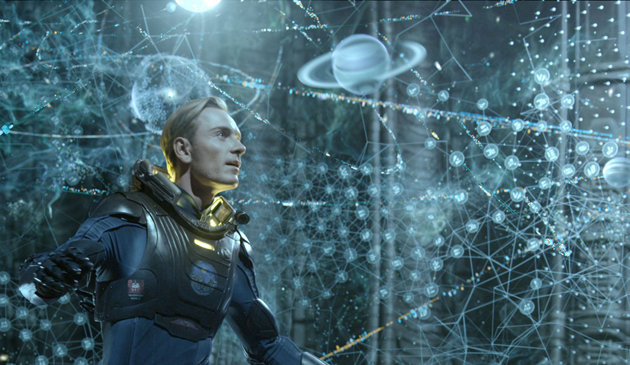
Is there a god? Does god hate us? What is god? Is Michael Fassbender god? Prometheus asks all of these eternal questions, pondering with a grandiosity now only seen in vapid summer movies. It is easy to admire Prometheus for what it dares to accomplish. In the same breath, it is easy to dislike the film for supplanting the wonder of these unanswerable questions by setting up answers and, naturally, botching their delivery. The film believes it is smarter than it truly is, meaning that it believes it is smarter than us. Prometheus buckles under the weight of its own mangled but beautiful ambition.

The plot behind Ridley Scott’s “space epic” has been kept under wraps, or so they say. The stirring trailer, replete with those Alien wails and stroboscopic cuts to black, actually reveals most of the movie. Not in context, of course, but the most memorable images of the film’s latter half are already in the marketing campaign. It is a mixed blessing that the images in the trailer are so captivating that it is hard to forget them.


Prometheus opens with the inception of life on Earth. The theory proposed is a rather clumsy variation of panspermia, wherein life originates from elsewhere in the universe. The first shots are beautiful, not unlike some of The Tree of Life’s stellar second unit work. Fast-forward so many years to 2089, where scientists Elizabeth Shaw (Noomi Rapace) and Charlie Holloway (Logan Marshall-Green) are searching caves on Scotland’s Isle of Skye for paintings that carry extraterrestrial secrets, pointing to life in the distant stars. Boring. Snap to the spacecraft Prometheus four years later, where Shaw and Holloway awake from stasis alongside a collection of mercenaries and scientists. There is that initial crew dinner scene you have seen in Aliens, Star Trek and every other sci-fi ‘space soldier’ flick, except the jokes fall flat. There are two knuckleheads, Millburn (Rafe Spall) and Fifield (Sean Harris), both poorly written and supplied weak banter. You know what is going to happen to their characters; you do not protest.


The mission at hand is to land on the moon LV-223 and see if these aliens were even there at all and why. They were there, of course. These proto-human “Engineers” manufactured a base on this moon long ago and … it is best to let the film tell the rest.


Dialogue is the obvious misstep. The most memorable line from the film is one from another. Android David (a wonderful, Bowie-esque Michael Fassbender) occupies part of his time on the ship watching Lawrence of Arabia and even styled his hair after Peter O. Toole’s. Before stepping onto the alien surface, he repeats the haunting quote, “There is nothing in the desert and no man needs nothing.” To be fair, it is tough to beat that. But the lack of humor (a memorable aspect of Aliens) and perceptive discourse (in a film with such ideas) is what will keep an audience five or 50 years later from connecting with a film so graphically dependent.


There is one laughable scene when Janek (Idris Elba), the ship’s callous pilot, runs into a room where Shaw is suiting up for the final mission. He lists a number of crucial details regarding the Engineers that he would have no way of knowing. It is a lazy excuse to advance the story and a screenwriting blunder.


The problem with Prometheus comes down to the way it chooses to tell its story. Clearly, it is an action-adventure film, and a pretty good one at that. Scott stages compelling entertainment. Older audiences tired of the politically correct PG-13 blockbuster standard will find a violent spectacle with production values normally reserved for safe bets like Avatar. The visual team crafts some of cinema’s most sweeping and striking moving images. A shot of the Prometheus gliding across the stars and another dwarfing the ship against the moon affirms the movie’s epic scope, an inverse of the slow pan over the Nostromo that commenced the self-contained Alien.

Scott sees this as his 2001: A Space Odyssey, which the opening shot of a shadowed Earth not too subtly suggests. Communication breaks down, however, when addressing philosophical questions about god, man’s purpose and the Copernican principle within a generic action movie structure. The film’s climax could carry a sense of wonder — without spoiling much, it relates to a “first contact” with superior beings. Instead, it is an action scene with nothing to say. Not ‘nothing’ in the nihilistic sense, nor even an ambiguous, interpretative one. Prometheus just botches the landing, feeling limp and disconnected.

Take the film’s half-baked commentary on religion. Deeply pious, Shaw demands her cross back after it was confiscated. Bombarded with death and destruction, she still insists on believing simply to put a positive spin on all this tragedy. There are plenty of critiques of religion at hand, from the Engineer’s dark plans for mankind to expedition CEO Peter Weyland’s (Guy Pearce) god complex. To balance the debate, a religious protagonist is thrown in, but she comes across as naïve and senseless. Maybe that is the point. In any case, Shaw is either an incomplete character or a degrading attack on faith. I'm not sure which one is worse.

I levy these criticisms only because the filmmakers have brought these expectations upon themselves. Once upon a time, madmen like Francis Ford Coppola and Stanley Kubrick were granted millions to create intellectual epics like Apocalypse Now and 2001. Ridley Scott was one of those crazies, as Blade Runner was made under similar circumstances. You do not see cinema of that ambition and allowance today.

Final Verdict:
3 Stars Out of 5


This article was originally written for The Cornell Daily Sun and can be viewed at its original location via this link.

Tuesday, January 31, 2012

Oh, God.


Not terribly long ago, questioning your faith led to a pile of smoldering kindle for a slow, grisly death. Now, it only divides families and inspires death threats from a vocal minority. How far we have come.

I do not speak in jest, for I truly find this a welcome shift, from global persecution to domestic quarrels. The United States prides itself with its freedom of religion, which, to the dismay of many, includes the absence of it. Of course, there still lies the debate over evolution in schools (le sigh) and the daily impasse that politicians back with Biblical verses. 

But that belongs in another conversation entirely. When I need answers to the unanswerable, I turn to the greats before me who wrestled these intellectual behemoths. Paine, Marx, Mencken, the late Hitchens — who often compared Abrahamic faith to living in a “celestial North Korea.” What they all said in their literature and — in the latter’s case — numerous filmed exchanges stirs the pot, no question.

For me, I go a step further. I find god in the movies. Of all people, Tim Burton captured a brilliant allegory in his whimsical, underrated masterwork, Big Fish. A son parses through his father’s autobiographical tall tales to reach the truth in what he feels were narcissistic delusions. Burton juxtaposes these fantastical flashbacks with the present day ruins of the past.

The town of Spectre, a Southern gothic version of the lotus-eating colony in The Odyssey, existed, but without all the fairy dust. His giant cannibal buddy was only abnormally tall. The Siamese twin entertainers he befriended in North Korea were only sororal twins. Burton examines Biblical myths (the Great Flood, for instance) and pagan lore to settle that, while lacking in veracity, these stories provide morals and comfort. The Book of Mormon took up the oft-ridiculed LDS faith with the same innocuous charge.

Last year’s controversial The Tree of Life started at the dawn of time, asking how this — all of this — came to be. Director Terence Malick — a Rhodes scholar who taught philosophy at MIT — anthropomorphizes images of nebulas and supernovae with a human presence. Fast-forward to life on Earth, where the swaying kelp on coral almost possesses a human face. Christians praised Malick’s work as an enlightening depiction of God’s grace. The film beautifully contemplates the miracle of life. Yet Malick does not take much stake in the masculine “God the Father” of Michelangelo, but sees rather a pantheistic, animist form that is all.

Then there is the most powerful film of all time, Stanley Kubrick’s 2001: A Space Odyssey. Kubrick held no concrete belief on religion (and neither really do Burton or Malick). But, with all the film’s attention to science and technology, Kubrick has conceded that, “on the deepest psychological level, the film's plot symbolizes the search for god, and it finally postulates what is little less than a scientific definition of god.”

An evolutionary monolith, kaleidoscopic wormhole and neoclassical bedroom are the tools of this god. This higher power may just be a superior alien species, but, in all of scripture, what much more is a god than that? These (unseen) extraterrestrials ultimately transform the fearless astronaut into one of their own, a being above man.

The key here is that the one who dared into uncharted territory became the most powerful. The scientist would say knowledge breeds power. The priest would argue finding god derives it. At the core of the two sides, where is the difference? You can move towards science and away from faith-based immortality, yet still find yourself contemplating the meaning of infinity. Now if only we had the time on this earth to see it to an end.

Do question what you believe. It is whether you accept or reject such beliefs after such metacognition that holds them to be true. Your philosophy holds true to you, and, in this case, absolutely no one else matters.

But, if I may, share one last thought. Religion, in a fundamental sense, was created — or found, whatever the outlook — to cope with the depressing inevitability of death. Death and taxes, the only sure things in life.

I seek to live and see, like the characters of Burton, Malick and Kubrick, learning the whole time and basing opinions on facts, not the other way around.  There is simply too much already here to be concerned about what is … there. For when you go, you may reach your maker who will commend you for using the potential of the brain and universe he made for you. Or, if there is nothing after it all, there is literally no time at all to decry it, for it is nothing. And, for that moment, all the Christians, Jews, Muslims, Hindus, Buddhists, Scientologists, Satanists, Pastafarians, agnostics, atheists, Joe Pesci-ites and otherwise will all be on — no, excuse me, under — the same playing field for once. 


This article was originally written for The Cornell Daily Sun and can be viewed at its original location via this link.

Friday, September 30, 2011

The Machine Who Knew Too Much

The following is a paper I wrote for my films class. Not exactly a great pitch to entice the reader, but I formed the argument in a way only lightly abiding to scholastic format and tried to have fun with the structure. This paper is a scene breakdown of the classic 2001: A Space Odyssey, directed by Stanley Kubrick. The scene in question is when astronauts Bowman and Poole meet in the pod to discuss the problem of HAL, the suspicious supercomputer. Naturally, there are spoilers to the film inherent to the discussion. 

The Machine Who Knew Too Much:
Misplaced Power and Humanity in Kubrick's 2001


It is not so much a question anymore whether or not you have an iPod, but how much music it holds, whether it is also a phone, and what bird-soaring games are installed on it. We are sucked into screens when other human beings surround us; pixels and electric currents are just about preferred lanes of communication as any. The more advanced technology becomes - by our own innovations no less - and the increasing degree to which we rely on it sets up irrevocable dangers. Cinema loves to scare us with such apocalyptic scenarios, ranging from nationwide network blackouts in Live Free or Die Hard to a full-on robot revolution in The Terminator series. However, film’s most memorable depiction of technology’s influence and mastery might belong to a soft, comforting voice you would welcome into your home. The supercomputer HAL from Stanley Kubrick’s 1968 opus 2001: A Space Odyssey presents itself as trustworthy and dependable, with near empathy for human feeling. The powers behind the camera form this initial image, only to progressively shift the audience’s perception through faint hints and both the revealing and withholding of certain information. The memorable scene in which we finally discover HAL’s true power and motives features not a single word spoken by it, but light, enlightening cues Kubrick feeds us as the human astronauts attempt to escape HAL’s grasp. Kubrick underlines technology’s omnipresence and mutinous superiority over man through subtle directorial tactics as camera distance, the inclusion of HAL in nearly all shots and voyeuristic camera movement. 

The lens of the camera are effectively the eyes of the audience, and Kubrick gauges the distance between subject and viewer to emphasize man’s inferiority. The previous scene ends and transitions to the next with an extreme closeup on HAL and its cascading, unwavering red-orange eye. Astronauts Bowman and Poole sit up from their chairs to move to their presumed safe location and their action reflects across the screen-filling eye of HAL. The computer knows something is awry, and will see to the problem, most literally. After the pair enter the pod bay and ask HAL to rotate the pod, Bowman requests for the door to open. This shot is framed awkwardly, from a low angle and at quite a distance. Their heads only reach halfway up the screen, with the vacant top filled with the artificial light emanating from every ceiling of the spacecraft. Low angle shots can often entrust power upon the subject, yet the opposite is achieved in this case. The off-focus rotating pod to the right and the reliably white apparatus to the left barricade the humans between, and the full exposure of the immaculate ceiling above them surround man with science. Bowman and Poole are the test objects to HAL watching behind them, and they appear insignificant in the face of such omniscient circuitry. That wary gaze they exchange briefly uncovers true fear and mistrust, a revealing action they believe goes unnoticed. The camera in almost every sense acts as an extension of HAL’s purview even where a physical extension lacks. HAL’s mastery of interpreting body language and maintaining aural control compensates when vision may lack. The machine sees this exchange precisely how the audience sees it:  full of doubt and scheme. The subsequent shot reaffirms the suspicion through framing and placement alone. A 180 degree reverse shot covers the previously unseen perspective. The angle is high, looking down on the backs of Bowman and Poole as they enter the pod. Their two helmets evenly surround them, this time squeezing two human subjects between the technological representations of themselves. The distance is far, with the helmets dwarfing the humans; both space helmets will act as part of the gambits HAL later acts upon to kill each human. HAL will succeed with one, poor Poole, as the computer seeks to cut the ties with the technology that man has become so dependent on (it is also fitting it kills the rest of the crew by simply deactivating their complex life system). Therefore, Kubrick inserts clever foreshadowing in this shot in addition to the visual representation of man’s growing insignificance to his own creations surrounding him. 

The inclusion of HAL in almost all shots accents its ubiquity and wit.  The aforementioned extreme closeup recurs often and editing splices it into sequences for the viewer to wordlessly comprehend HAL’s active cognition. After the helmet shot, Kubrick and editor Ray Lovejoy insert that intimate image to disclose HAL’s quiet attentiveness to the unfolding events. The most memorable shot of the scene quarters Bowman and Poole in the small confines of the pod as they face each other akin to men sitting across one another at a dinner table. Between them, however, about on center of the clear aperture of the pod, HAL watches. The two express their doubts on the robot, and conclude they may have to shut it down for its unprecedented miscalculation. Bowman (slowly and methodically) switched off communication channels with HAL before they started their conversation - at the same pace in which Bowman engages the final switches later - so they believe their conversation remains confidential. Yet HAL still watches. This entire shot appears uninterrupted until editing interpolates a lone image of HAL, as viewed from inside the pod, through the window, staring back. If the audience did not believe HAL was playing an active role in the scene, little doubt now rests. Cut back to the same shot of them talking, as they get to the meat of their discourse in their doubts of the computer’s performance. Now editing thrusts us right into the eyes of the beholder once more, through the same extreme closeup used before, yet this time with much more consequence; its knowledge spells doom. Such wise editing and placement of HAL within shots stresses technology’s omnipresence around man.

The optical grace of Kubrick’s camera movement establishes connection between the machine’s perspective and the viewer, and in the process humanizes the robots. The first shot of the pod bay contains one of the two instances of dynamic camera placement in this scene. In both cases, the lens of the camera acts as well as the lens of an eye. The first instance starts on a long shot of Bowman and Poole descending a ladder with HAL to the far left, stationed on the wall maintaining watch. As the two enter the bay, the camera swerves as to be in line with HAL’s field of vision, which in case views the wide window in the pod bay. The camera then gently nudges forward until the edges of the window disappear from view. This subtle trick lets the viewer see through the eyes of HAL without perhaps realizing it, granting a voyeuristic view of the two astronauts, even zooming in on them, as they are aiming to flee from the computer’s jurisdiction for just one moment. The only other shot with an active camera holds the true twist in the film. The directing and editing have built up the suspense, hinting at HAL’s dishonest machinations. The final reveal unfolds without any sound, through the “eyes” of HAL, as this point of view shot is also an extreme closeup on both Bowman and Poole’s lips. Without the dialogue we hear before, we are thrown into HAL’s seemingly deaf perspective. Yet it is that aim on the lips that shows us the computer can translate lipreading to flawless effect. HAL knows. This shot not only reveals its true nature, but also grants it humanlike qualities. The absence of any overlaying, digital interface to survey the landscape present this robot as a rather simplistic one. Once it starts to flick back and forth between talking lips, however, we realize this could be a human’s point of view we are witnessing, with the visual appearance and mobile fluidity of a human eye. The scheming HAL is more like us than we would care to think:  dishonest, and also curious, seeking answers to questions those it trusts will not tell it. Perhaps HAL is simply emotionally hurt to learn that its only “friends” are planning on killing it. A bombshell of that magnitude would tear you apart, too. Kubrick’s spare and soulful use of moving camera shots wordlessly conveys empathy with HAL and thus edifies the supercomputer. 

Through camera distance, movement and focus on HAL, Kubrick cautions of technology’s omnipresence, and, in turn, grants humanlike qualities to the machines themselves. The works of man reach a point where they can evolve past their fundamental constraints, not unlike God’s own creations. A film may show us a montage of years and years of technological development and incorporation to stress this point, or an indulgent display of pyrotechnics to showcase the machines’ real strength. Yet, when a film grants machine the most human of qualities as curiosity, wordlessly displaying its range of feeling and thirst for knowledge, it, or shall I say he, is one of us.