Showing posts with label breaking bad. Show all posts

Tuesday, March 18, 2014

Need for Speed Review

Need for Speed
Directed by Scott Waugh
Released in 2014

Now, here is a video game movie. Typically, Hollywood buys the rights to a game like Prince of Persia: The Sands of Time for typical, Hollywood reasons: an exotic, albeit totally depoliticized, setting; a nifty time travel conceit; a male lead who can look good while swinging a sword. Need for Speed, a 20-year-old series of racing games, has no core locale, no human characters and no story. Back in fourth grade, I played Need for Speed: Hot Pursuit 2 on GameCube because it had a McLaren F1 LM that went so fast I could lap the cops chasing me. That simple pleasure motivates this adaptation, a film so poorly written and devoid of any self-awareness that its fundamental, thematic emptiness makes it a fascinating text, as well as a superficially, stupidly enjoyable one.

As if to prove its commitment to The Real and the spirit of Americana, Need for Speed spends its first 30 minutes in Westchester County. Because when we think muscle cars and blue collar roots, we think Westchester and, to be specific, Mount Kisco. I have visited that town before and found it surprising how the production transformed a town of 10,000 into an urban center 20 times as large. Turns out it filmed those scenes in Columbus, Georgia. Why didn’t the movie just start there?

I am at a loss, and so is Breaking Bad’s Jesse Pinkman, née Aaron Paul — here a mechanic named Tobey Marshall, who has spent his whole life in the town and never once boasts about a local restaurant or expresses any sense that he lives in an actual place that he either longs to break free from or hopes to never leave. The most he can summon is “Are you still allergic to Mount Kisco?” to an ex (Dakota Johnson) at a yellow-tinted, Drive-esque drive-in theater. Even the thespian who could break down at the sight of a vial of ricin has little clue what to do with a line like that.

Tobey gets his diverse — sans Asian dude, unlike The Fast and the Furious movies — band of bros pumped for the initial conflict when he mutters, “I’m, uh … behind … on the loan.” When Benny (Scott Mescudi, a.k.a. Kid Cudi) interjects about “last time,” Tobey, via the pen of screenwriter extraordinaire George Gatins, says, “This time is different,” and, “If you guys don’t show up tomorrow, we lose this place.” That place is an auto shop/man cave they run now that Tobey’s dad has passed, just before the movie starts so that his cause of death can remain perpetually and pointlessly cryptic. It takes another death — this time of Tobey’s closest friend, after schoolyard bully-cum-racing millionaire Dino Brewster (Dominic Cooper) bashes his fast car with his own fast car and instigates a fiery, though undeniably pretty slow-mo inferno — and the framing of Tobey, with Dino going scot-free, to set up the barest outline of a conflict: For Tobey to win the De Leon, a secret race of modified supercars, in order to, somehow, prove his innocence and reassert his masculinity in the process.

This may not be obvious so far, but every character in Need for Speed is a terrible human being. Dino Brewster kills people, sure, with his pride and fake name and all. But the supposed good guys are sexist, unfunny idiots, too: Little Pete (Harrison Gilbertson) flirts with Tobey’s British love interest, Julia Maddon (Imogen Poots), with winning lines like, “I really like Piers Morgan.” The only discernible arc in Tobey’s character is in his eventual acceptance of Julia as an actual person, only after she drives well and helps him evade police custody. Meanwhile, violence against pedestrians or civilian cars is ignored or even glorified: When Pete hits a homeless man’s shopping cart during an earlier street race, he smiles and laughs as the man screams, “My house!” During every race, Tobey manages to cause at least a half-dozen car pileup by driving on the opposite side of the road and cutting off SUVs and even school buses.

Naturally, the film never indicts its characters’ behavior. Whereas Transformers 2 can be easily lambasted for its offensive stereotyping, director Scott Waugh maintains a weird, remarkably open visual style that is either lazy assembly line craftsmanship or sly, subversive commentary. The host behind the De Leon game is none other than a nutty Michael Keaton, going by “The Monarch.” He spews pop philosophy into his microphone and webcam, like “Racing is art. Racing with passion — that’s high art.” Everyone in this film knows him and thus reveres him, and you wonder if his marked isolation, in a circular room with a long-suffering swivel chair, clues us into his questionable sanity. Is he any different from The Joker and his home videos in The Dark Knight? Through the grammar of film, he is not, or not by much.

Then there is Benny, who commandeers a news helicopter and eventually a U.S. Army helicopter for reconnaissance during Tobey’s cross-country trek. He could bring down the whole American military with his smile and gift of gab, which Waugh shows us whenever he can, whether on-screen or through isolated intercom. That all these dudes get away with their reckless, irresponsible behavior and never even reflect on their violence could be just brainless filmmaking, or perhaps a super-ironic treatment of machismo and other harmful byproducts from exclusively homosocial relationships. I mean, given that one of the last shots is Tobey looking up at white lighthouse, framed askew so it juts about 45 degrees across the screen, is it wrong to think a queer reading of this entire thing is in order? This is one of those films that is all surface, and inadvertently or not, the motivation behind such surface-level violence lies underneath it all, if you are willing to look. It’s fun, dumb and sexless enough that it already feels like a camp classic.

Final Verdict:
2.5 Stars out of 5

This article was written for The Cornell Daily Sun and can be viewed at its original location here.

Monday, October 7, 2013

Breaking Bad's Top 10 Episodes

*Co-written with one of my editors at The Sun, Sam Bromer, whose excellent work is designated by an asterisk*

Well, we’ve made it one week so far, and, from the looks of it, we’re going to be just fine in a world without more Breaking Bad. That being said, The Sun would like to offer one final feature on what pretty much everyone has canonized as one of the greatest television shows of all time. Breaking Bad was stellar from start to finish, but, like any show of this caliber, there were some episodes that approached something close to perfection. Below, you can check out the 10 episodes we ranked above the rest. It’s an impossible task that will piss off fans no matter what (“Where’s ‘One Minute’?” ‘Felina’?!), yet we hope you’ll revisit these episodes when you have some free time on your hands or, better yet, when you don’t.

1. Phoenix (Season 2, Episode 12)
Our number one pick does not boast the kickass firepower of “Face Off” nor the perfect dramatic unity of “Fly” or “4 Days Out.” Indeed, the one where Jane dies is very typical, in action and narrative structure. What it does do better than any other episode, however, and through the most moving, startling ways, is come to grips with what makes Walt tick. From Walt beaming as he shows newborn Holly the stacks of cash hidden in the garage to his look of wounded pride when Walter Jr. posts a charity site for his father’s cancer, money — for, and within, the family — appears to be Walt’s motivating factor. But things complicate when Jesse and his girlfriend Jane blackmail Walt for Jesse’s cut. Walt standing over Jane’s asphyxiating body, allowing her to die, is horrible enough, yet it arrives just moments after, by mere chance, he runs into Jane’s father at a bar, where they talk about the difficulties of “family” and how “You can’t give up on them.” Money sets the pieces in place while one man’s selfish need for control assumes the truest power. “Phoenix” is the turning point of the series, as well as a perfect microcosm of all Vince Gilligan was going for. And it is devastating.

2. Ozymandias (Season 5, Episode 14)*
No, the episode named by dozens of critics, thousands of IMDB users and even Vince Gilligan himself as the best episode of the series is not our number one pick. But that does not mean it is unworthy of the heap of praise it has received: “Ozymandias” is Breaking Bad at its most thrilling, its most powerful — and its most sickening. From the moment Walt’s “shattered visage lies, half-sunk” in the sands of To’hajiilee, it is clear he, and by extension, we, have turned a dark corner; as the AV Club’s Donna Bowman succinctly points out, the Spaghetti Western vibe of Breaking Bad’s highly stylized previous episode devolves into a veritable “horror show.”
Unsurprisingly, Bryan Cranston is at his absolute best in “Ozymandias.” As the empire he has built is reduced to rubble, with nothing remaining but a solitary barrel of cash, Cranston earns his accolades, presenting both the frantic desperation of a man trying to salvage something from nothing and the chaos of two personalities clashing into one. Even as he rats out his former partner, kidnaps his own daughter and threatens his wife over the phone (albeit to ostensibly help her), it is disconcertingly difficult not to feel sympathy for Walter.
“Ozymandias” works breathtakingly well on all levels; as a character study, as a thrilling climax and as a perfect nightmare scenario, where our greatest fears for these characters, spurred from the earliest moments of this series, become a reality.

 3. 4 Days Out (Season 2, Episode 9)
This bottle episode (an episode filmed on mostly one set and a limited budget) is impossible not to love. After discovering what he thinks is a ghastly tumor on his x-ray, Walt recruits Jesse to cook one last batch of meth, far out in the boonies. What starts as brilliant comedy — Jesse lectures Walt on artist Georgia O’Keeffe: “She does these vagina pictures” — nosedives into survivalist horror, when the RV’s battery explodes and Jesse pitches all their water on its fire. Walt nearly gives up hope and accepts death, which is right around the corner for him anyway. It takes Jesse’s persistence to shake Walt out of it, plus a great line where Jesse declares with confidence that “wire” is a chemical element. Things get back onto track … until Walt receives his x-ray results back: He’s clear, in remission. After hugging and crying with his family, Walt retreats to the bathroom, where he beats a paper towel dispenser to shit. He already accepted death and evil in his life, and without one, he’s destined to succumb to the other.

4. Fly (Season 3, Episode 10)*
Thank God for budget constraints. Like “4 Days Out,” “Fly,” the acclaimed and largely self-contained masterpiece from Breaking Bad’s third season is a bottle episode. On a functional level, its plot adds little to the overall story arc, and if you’re looking for tense gunfights or nursing home explosions, look elsewhere. Yet, as a singular allegory for Jesse and Walt’s mercurial relationship, a darkly comic exploration of the forces at work in Breaking Bad’s universe, “Fly” is unmatched. In the episode, Walt, suffering from insomnia and paranoia, becomes fixated on finding and killing a fly that is “contaminating” the lab.  At the heart of this tale, whose sensibility lies somewhere between the obsession of Moby Dick and and the absurdist slapstick of Waiting for Godot, is a monologue delivered by Walt in another of Cranston’s finest hours. “My God,” he exclaims, “the universe is random, it’s not inevitable, it’s simple chaos. It’s subatomic particles in endless, aimless collision. That’s what science teaches us, but what does this say? What is it telling us that the very night that this man’s daughter dies, it’s me who is having a drink with him? I mean, how could that be random?” Unable to resolve the existence of justice in a disordered universe, he gives up trying. As he defeatedly tells Jesse just before the episode’s close, “It’s all contaminated.”

5. Better Call Saul (Season 2, Episode 8)
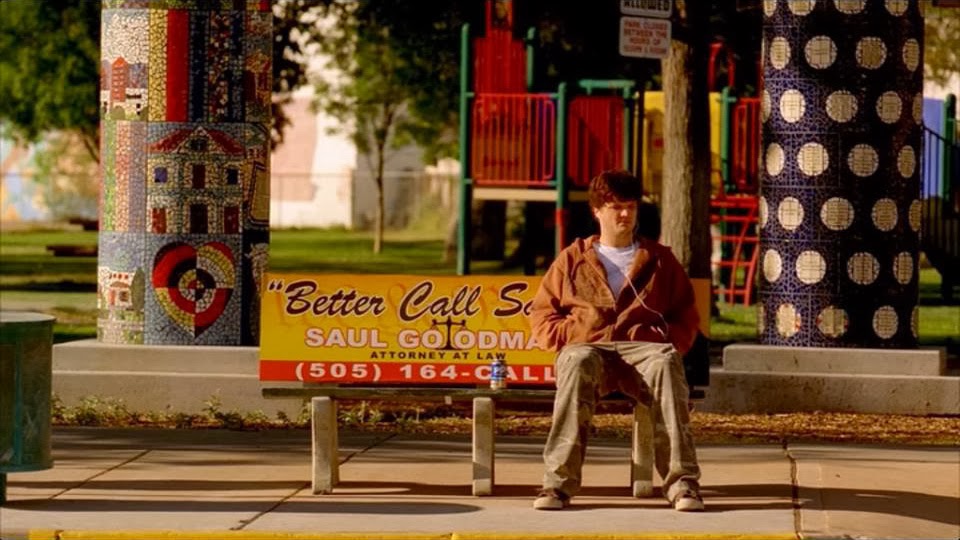
As a sign of the show’s many layers of greatness, Breaking Bad’s funniest episode is also one of its most cinematically ambitious. It opens with a single long shot of a lanky dude coercing Badger into selling him some meth. When that dude turns out to be a DEA agent and the deal a bust, you realize that long shot was probably a camera in a surveillance van across the street. Brilliant! The introduction of everyone’s favorite bus-stop lawyer, Saul Goodman, produces some of the series’ most memorable lines (“Faith and begorrah! A fellow potato eater!”) and leads to a criminal-for-hire taking the fall for Heisenberg — but only after everything goes wrong. It’s as rigorously edited a sequence as any meth-making or prison-shanking montage, and a million times more hilarious.

6. Crawl Space (Season 4, Episode 11)*
A single moment alone justifies this episode’s inclusion on any Top 10 list. In case you can’t remember the iconic moment to which we refer, here’s a refresher: Walter enters the crawl space for which this episode is named, expecting to find the money he needs to escape Gus Fring with the vacuum man. Instead, he finds an empty basement. Panicked, he begs Skylar to explain where the cash has gone, and she tells him, in a tone of measured terror, that she has given it to Ted. Walter, beginning to lose track of his sanity, breaks down. as the camera pans out, framing Walt in a coffin of his own misdeeds, he laughs maniacally. All the while, the sounds of mechanical feedback echo as the only sound in a void. There is only terror — then the credits roll.
Oh, and the rest of the episode works well, too.

7. Madrigal (Season 5, Episode 2)
Better than “Box Cutter”? “Dead Freight”? “Face Off”?! With its cocktail of tones, palettes and character moments, yes, “Madrigal” earns its rank. The cold open delivers a concentrated shot of delirium as a blank-eyed and silent German businessman taste-tests various condiments before committing suicide by automated external defibrillator. As a way to show the scope of Gus’ and Walt’s meth empire, the scene could not be more off-the-wall. From there, you get Jesse’s anguish over his “misplaced” ricin, Lydia’s horrifying pleas to Mike as he holds a gun to her head and Walt’s sickening bedroom abuse of Skyler. Good shows can live off dynamite set pieces and season finales, but only the greatest keep you riveted as the pieces are slowly put into place.

8. Face Off (Season 4, Episode 13)
First off, let us clarify that “Face Off” would be higher if not for the last scene’s Lily of the Valley reveal, which we buy but still consider a stretch. That being said … wow. Gus and Walt’s game of chess ends with a pawn, wheelchair-bound Tio Salamanca, taking out the mighty king. “Ding-BOOM,” read a card tacked onto the writers room’s board months before they wrote this episode, and we are grateful Gilligan and co. pulled all the stops to make it happen — even the ricin gambit, sure. But we most love Uncle Tio’s extended flip-off to the DEA, communicated one letter at a time, in order to lure Gus into Walt’s trap while ensuring he dies without becoming the most dreadful of creatures: a rat.

9. …And the Bag’s in the River (Season 1, Episode 3)*
Classic moments are scattered throughout this early episode, often marked by Breaking Bad aficionados — myself included — as the one that got them fixed on the series. Among these, two deserve “classic status” among the pantheon of great scenes. First, the cold open, where the camera switches off between Walt and Jesse struggling to choke back vomit as they clean the hydrochloric acid-soaked remains of Jesse’s former partner, and a younger Walt discussing the mysterious chemistry of the human body with Gretchen, then a fellow chemistry student. Second, a more simple, but equally powerful, scenario: Walter weighing the pros and cons of killing Krazy-8, a meth dealer who had previously attempted to kill him and Jesse.  The sole pro? “He’ll kill your entire family if you let him go.” In a single scene, Cranston and the writers manage to encapsulate Walter’s constant justification for his actions: he must protect his family, and it is better they than he. As the show goes on, of course, Walt bastardizes this logic, letting, “I did it for family!” justify increasingly heinous actions. In doing so, he becomes the danger.

10. Dead Freight (Season 5, Episode 5)*
Breaking Bad has it all, as the above list has attempted to illustrate. From slapstick humor to mortal terror — and everything in between — the show manages to pay homage to several forms of art while paving a strikingly original path. In “Dead Freight,” Gilligan and Co. take on the caper. In fact, in the vein of the Westerns they so love to reference, the writers have Walter and his team pull off a train robbery. Of course, they do not go in guns blazin’ — though the murder of Drew Sharp provides an exception. No, Walter is smarter than that. In one of the most captivating exploits of the series, they use ingenuity (science, bitch!) to pull off their bold plan. It is a fine example of Bad’s flexibility, and a thoroughly entertaining watch from start to finish.

Honorable Mentions: “Over” (Season 2, Episode 10), “Box Cutter” (Season 4, Episode 1), “Gliding Over All” (Season 5, Episode 8), “Half Measures” (Season 3, Episode 12), “To’hajiilee” (Season 5, Episode 13)

This article was originally written for The Cornell Daily Sun and can be viewed at its original location via this link.

Tuesday, October 1, 2013

Breaking Bad: "Felina" Review

"Felina"
Breaking Bad
Season 5, Episode 16
First run on September 29, 2013

“When Alexander saw the breadth of his domain, he wept, for there were no more worlds to conquer.” — Hans Gruber, Die Hard

This quote often serves epigraph duty atop reviews of films and television shows because, let’s be honest, a lot of the protagonists we love are extraordinary men (and, for better or worse, they are men) who live for the struggle. They face a problem, set a goal and barrel so furiously towards it that when they reach that peak, they find it constraining, foreign, flavorless. Whatever motives they had at the outset have molded to this new self-centered, usually violent way of life. Donna Bowman of The AV Club cited the quote in her review of last year’s mid-season Breaking Bad finale, “Gliding Over All.” Back then, ages ago, Walter White realized his dreams of power, money and infamy with as smooth and lucrative a meth operation he was ever going to get. Yet he was exhausted with the monotony of his work and the emotional distance between him and every member of his family. A lot has happened since then, but that quote still applies.

It applies to us, more than anyone or anything else. How are you managing? “Felina,” the series clincher, ties up about every loose end and hits all the right notes. It’s about as perfect a finale any of us could hope for — perhaps too perfect. After all that change, all that bloodshed, all those montages and minerals, Vince Gilligan ends it all on a note of startling, almost uplifting finality. I want to give him either a standing ovation or a punch in the face. The latter more as a coping mechanism because, come on, does he expect Homeland to fill the gap he’s left us? But, on point, that last scene is beautiful, albeit hardly surprising. In contrast with his catatonia in “Gliding Over All,” here Walt greets that dingy meth lab — the remnants of his domain, of all that he built — with a smile. A smile, a cue from Badfinger’s “Baby Blue,” a slip of a bloody hand, a contented corpse, a crane shot ascending to heaven or else sending that soul to hell and one final cut to black. I watched that last shot with a breathless smile, yet I could not summon the expected tears. I’m not sure if that is the show’s fault or mine, or if that is the even the tone Gilligan was aiming for, or what that tone is. Ending a show built on moral ambiguity is tricky business.

“Guess I got what I deserved. Kept you waiting there too long, my love.” — Badfinger, “Baby Blue”

A stray bullet from his own jury-rigged M60 finishes what cancer started 61 episodes ago, so why does Walt look so happy? Perhaps because he goes out without a shred of bullshit between him and those he loves and those he hates. As for those he hates, he lets Uncle Jack know money has nothing to do with it via a bullet to the head. He boasts to a dying Lydia how easy it was to slip her some ricin, how predictable she is after all her precautions. He kills all the neo-Nazis because they’re scum and the sloppy antitheses to Mike and Gus, criminals he admired and emulated. He lets Jesse strangle the life out of Todd’s already lifeless eyes because Jesse has more than earned it, not to mention the privilege to finish his own. Jesse’s refusal to put Walt down is one of the show’s final, humanistic triumphs, in which the corrupted breaks free from the corrupter to drive, cackling and crying, toward the sunset. Perhaps Jesse will finally find his way to Alaska, or into the apprenticeship of some old bearded woodworker, one equally wise as Walt but nowhere near as toxic.

“Cheer up, beautiful people, this is where you get to make it right.” — Walt to Elliot and Gretchen

Because Breaking Bad made its name as the funniest serious show on TV, “Felina” balances its late-act slaughter with some seriously funny, somewhat horrifying preamble. In a scene none of us saw coming, Walt saunters around the postmodern, largely hollow mansion of Gretchen and Elliot Schwartz like Jacques Tati’s Mr. Hulot. Gilligan, who penned and directed “Felina,” emphasizes the Schwartz’s empty space and towering doorways against the stooped, narrow hallway of the White house. Walt may come across like a zombie — or, according to Vulture’s Matt Zoller Seitz, A Christmas Carol-esque ghost — but he’s still as brilliant as ever. He’s got that pissed-off-at-the-world Falling Down vibe about him, which about sums up his feelings for Gretchen and Eliot, yet he knows their dearly valued comfort will ensure that his remaining millions go to Walt Jr. when he comes of age. That “the two best hitmen west of the Mississippi,” Badger and Skinny Pete, are a pair of laser pointers, Badger and Skinny Pete, both perfectly willing to cast aside moral quandaries in favor of stacks of cash, just reaffirms the basic motivations that drive most of the characters in this world.

 “Back in El Paso my life would be worthless. Everything’s gone in life; nothing is left.” — “El Paso” by Marty Robbins

With that: Why, oh why, did Walt return to ABQ in the first place? That fascinating cold open, just of Walt sitting there in a car, deserves a revisit. It opens with a gray, out-of-focus, neutral palette, like this year’s opener “Blood Money,” which opened on the White’s pool-turned-skate-ramp. After some scratching and shedding of snow, this grayness reveals to be a driver’s window, the corner of which frames Walt’s bearded, desiccated face. Gilligan employs a ton of frame-within-a-frames in this episode (in this shot alone, two of them), which could be a subversive hint to stop judging, scrutinizing, entombing Walt — like a work of art — before he has his final say. He nearly freezes to death there in that car, the glare of police lights reflected in his thick-framed glasses (there it is again). But when he finds the keys and gets that car running, we are with him, in a close-medium shot, as he smacks the snow off the window and gets one last show on the road.

“I did it for me. I liked it. I was good at it. And I was really … I was alive.” — Walt to Skyler

Even with that one frigid, cloistered moment and all that long-overdue revenge, no scene spelled true catharsis like those words. Before Skyler in her cramped flat stands neither Heisenberg nor the Walter White who justified every terrible thing in the name of family. Here is Walt, changed by his actions and, for once, true to them. That does not make him a hero, not after all he’s done — perhaps that’s why the celebratory tone of the final shot confused me, even as it moved me. If anything, that line sequesters Walt into the darkness once and for all. He seems happy there. I’m reasonably happy, too. I’m about as happy as I can be, greeting the finale not as the end of greatness but as yet another completion, now enthroned to history.

This article was originally written for The Cornell Daily Sun and can be viewed at its original location via this link.