Tuesday, August 21, 2012

The Greatest Films of Me Time


The years drag by between this special August day. We can recite by heart the rankings last time around, but we hear a potential contender has a chance to topple the king. This time, the two will go face-to-face. The moment of truth has arrived. Spectators across the world open a new Internet tab and … check Twitter? Well, yes. This is not the Olympics and the contestants are not Michael Phelps or Ryan Lochte. This is cinema as filtered through the British Film Institute’s decennial Sight & Sound Poll and Alfred Hitchcock’s Vertigo is set to seize the throne from Orson Welles’ Citizen Kane as the de facto “Greatest Film of All Time.” And it did, as revealed by Sight & Sound’s Twitter account on August 1.

This is how it goes: Every ten years, the magazine Sight & Sound polls an exclusive list of critics, historians, theorists, distributors, exhibitors and other legit types on their picks for the ‘Top 10’ films. There were 846 voters in total (my employer at distributor Milestone Films was one of them) and they do not fall for the politics or marketing campaigns that plague the Oscars. The poll is, as Roger Ebert summarizes, “the only one most serious movie people take seriously.

So, the displacement of Citizen Kane from “Greatest Ever” status — which it held for five decades — in favor of Vertigo means sacred ground has been plowed, tilled and declared sacred anew. But not really, of course. There is no official “greatest” film, just as there is no greatest song, painting or aleatory cut-up poem. The best these academics can do is talk amongst and with themselves to decide which groundbreaking film broke more ground than that other groundbreaking film, or which artistic feature packed more beautiful art than that other artistic feature. It is quite silly and arbitrary when viewed from afar.

Considering that we witness every action and absorb every expression through our own eyes, it is impossible to divorce emotion from judgment, lest we become readymade Sight & Sound clones declaring their final list as fact. I think it would be irresponsible as a critic to hold a select few titles above all else just because they introduced this technique or inspired that director. Intuition, recognized through emotional response, should rule the sorting of great art. A masterpiece should strike an initial impression of awe, love, fear or even downright resentment, only for a closer read to enhance or reverse these feelings. The worst offense is causing no offense.

I both criticize and defend the Sight & Sound Poll. It settled on some truly wonderful films, like Yasujiro Ozu’s Tokyo Story, ranked at number three. I finally saw it because of its placement. The poll is more a glorified list of movies to watch for budding cinephiles than any stone tablet of truth. You would be a fool to take any of it for granted. I personally disagree with some of their choices, namely Vertigo as the number one pick. It is a haunting, dense work, one worth exploring in one of the many film courses you can take here at Cornell. But it is also a cold and distant study of obsession and creation, telling the story of a man who struggles and fails to craft the perfect woman from a memory at odds with her very flawed reality. No wonder it is the critics’ favorite; it tells their story. The Rules of the Game, number four on the list, survives today as a fascinating and witty portrait of pre-war bourgeois ideals, though I question anyone it touched on a personal level. Same goes with The Battleship Potemkin and much of Jean-Luc Godard’s work; they innovated the art form but should be remembered most for the more engaging fare they inspired.

This is all my opinion, of course, and that is the point. The logical fallacy the horrid Rotten Tomatoes community always shrieks — “You did not like Classic A so your opinion is invalid” — only elevates my respect for the targeted critic (often Dave Kehr or Armond White). There is no perfect movie, and we should revisit these monuments and check if their architecture really is sound. Admiration for art should come from within, not egged on by external pressures.

The line between “favorite” and “best” in these circumstances really is thin, if not existent. “Guilty pleasures” are a whole other thing — Rush Hour 2 would not be caught within a million miles of my Sight & Sound list, though I still deign to watch it with a smile. But for someone who has watched dozens if not hundreds or thousands of quality films, why reiterate the standards when you have the rare moment to reflect and think yourself? Think back to the moments that took your breath away and raised the hairs up on the back of your neck.

For me, those are HAL’s “Daisy” from 2001: A Space Odyssey, the Ride of the Valkyries in Apocalypse Now, Susan’s opera in Citizen Kane, Marge’s “It’s a beautiful day” speech from Fargo, the father’s visit in La Dolce Vita, the final frames of City Lights, the duster attack from North by Northwest, the U.S.S. Indianapolis story in Jaws, “La Marseillaise” from Casablanca and the Creation from The Tree of Life. There are some unimaginative picks as well as some disagreeable ones. But the list is mine, me, myself.


This article was originally written for The Cornell Daily Sun and can be viewed at its original location via this link.

Monday, August 20, 2012

Tony Scott: Action Architect


The sad and untimely death of Tony Scott, a director who continually raised the bar for blockbusters since the early 1980s, will confuse his fans for years and those closest to him for even longer. The New York Times reported that Scott jumped from the Vincent Thomas Bridge over Los Angeles Harbor at about 12:30 local time Sunday afternoon. Authorities have found a suicide note and all signs point to such a conclusion.
I did not know the man but those who did, colleagues like director Duncan Jones (Source Code) and actor David Krumholtz (Numb3rs), took to Twitter and described him as a “warm,” “lovely” and “rambunctious cinematic spirit.” Tony Scott’s death saddens those of us who enjoyed his prolific output of quality entertainment. Stranger yet, his final choice stands at odds with the optimistic energy consistent throughout his work.
His older brother, Ridley, claims icon status for cinematic heavies like Alien, Gladiator and Blade Runner. Tony’s filmography commanded less critical acclaim but reeled in equal if not, by some measurements, greater commercial success. Top Gun, his biggest hit, ruled 1986, cementing Tom Cruise as an official movie star and spawning an immortal quote — “I feel the need … the need for speed!” — scrawled on vintage T-shirts and the most successful racing video game franchise in the world. The phrase “crowd-pleasing blockbuster” that we now bestow upon witty and slickly choreographed summer fare like The Avengers and The Amazing Spider-Man was in large part defined by Scott’s work.
Many obituaries yesterday started with ‘Top Gun Director’ in the headline, which makes sense since it made the most money of Scott’s films and occupies a [rather large] spot on the ’80s pop culture tapestry. College-age observers (very likely you) have little connection with Top Gun, Scott’s other Tom Cruise flick, Days of Thunder, The Last Boy Scout or even Beverly Hills Cop II. Most of us can recall his kinetic output since the late ’90s, with Brad Pitt in Spy Game, Keira Knightley in Domino and Will Smith in Enemy of the State. Denzel Washington was clearly Scott’s go-to actor; the pair honed a formula with Washington as the conflicted but always sympathetic lead against Scott’s stunning set pieces and steady firepower. See Crimson Tide, Man on Fire, Deja Vu, Taking of Pelham 1 2 3 and Unstoppable. They told thrilling stories with human characters and boasted Hollywood’s greatest action scenes.
True Romance will likely solidify as Scott’s most memorable accomplishment. While one of his least profitable movies, the 1993 crime film is constantly revisited because of its script, written by a young Quentin Tarantino, hot off the heels of Reservoir Dogs. I watched it for the first time this summer and was struck by how Scott molded the violent screenplay with a genuine sincerity absent from Tarantino’s darkly ironic films. There are two famous bedroom brawls — one, a fistfight between Patricia Arquette and James Gandolfini, and, two, a full-scale shootout between basically the entire cast. They each cut shot-after-shot with that effortless logic natural to Scott while affectively reflecting on all the human carnage. Shots of colleagues, friends and lovers bleeding next to each other — whether physically so or effectively through cross-cutting — punctuate the destruction and convey a tinge of loss that adds a third dimension to the zany bloodfest. It is not a stretch to think of Scott as a romantic; he threw his many characters into such extreme circumstances and always ended on a happy note, as if to assure us no evil can vanquish good.
So the necessity to reflect on his life, at this time and under these circumstances, shocks me still. Suicide is the most personal decision one can make, so no one will ever know the extent of torment that drove him to that bridge. Why would we want to, anyway? Scott already won the respect of his colleagues and millions of moviegoers. It is safe to consider Tony Scott one of the great masters of his craft; the others who come to mind are Steven Spielberg (Indiana Jones), James Cameron (Terminator), John McTiernan (Die Hard) and John Woo (Face/Off). They create entertainment with the intent of pleasing the audience. Clarity of subject and technical precision rule every shot. And, for Scott at least, there was a heart beating beneath it all.


This article was originally written for The Cornell Daily Sun and can be viewed at its original location via this link.

Thursday, July 26, 2012

The Dark Knight Rises Review

The Dark Knight Rises
Directed by Christopher Nolan
Released in 2012

A record 70 minutes of footage from The Dark Knight Rises was shot using IMAX cameras. IMAX theaters stand about five stories tall and used to only screen movies about mountains and sea turtles. Since Christopher Nolan’s Batman predecessor The Dark Knight pioneered Hollywood’s use of these cameras with 30 minutes of IMAX in 2008, these giant theaters now rattle with loud bouts of action. Because IMAX cameras emit loud buzzes or whirs or whatever sound they make while operating, actors must dub over their lines in post-production. Layering heavy, percussive score over the soundtrack sounds like the other solution, at least the one these audio mixers devised.

I list these facts and observations because, for all the moments The Dark Knight Rises fills the screen and sonic space with intricate, thundering shoot-outs and fistfights, the more apparent it becomes that noise rules over silence, brawn over wisdom and text over subtext. Naturally — but not effortlessly — the last entry in Batman’s War on Terror trilogy boasts immaculate production familiar to Nolan’s prior masterworks like Memento and Inception. Many talented Nolan collaborators return, such as cinematographer Wally Pfister, production designer Nathan Crowley and editor Lee Smith. The two hour, 45 minute film keeps pace but its energy does not sustain from fresh set pieces or inspired ideas as much as a maximalist take on terrorism that oversteps The Dark Knight’s tasteful balance.

Before the obligatory plot outline, I must mention one exception to that thesis above. Batman’s foil, Bane (Tom Hardy), makes a spectacular entrance. We meet Bane hooded and handcuffed on a CIA plane. When help arrives, he not only escapes but destroys the aircraft and all in it. His soldiers rappel from a bomber above, tearing apart the plane with wires and aerodynamics, and descend into the vertical fuselage to retrieve Bane and a nuclear scientist (guess what the scientist will do). As per his style, Nolan inserts a bizarre detail in the middle of the action — transfusing the scientist’s blood into a lookalike corpse — that, while biologically and forensically infeasible, leaves a brutal signature. This prologue was screened before IMAX showings of last year’s Mission: Impossible — Ghost Protocol and stands alone, then and now, as a thrilling and appropriately terrifying assemblage of creative stunt work and computer effects.

From here, the plot picks up eight years after Batman took the blame for Harvey Dent’s murders in collusion with Commissioner Gordon (Gary Oldman), who continues to perpetuate the lie despite a clawing conscience. Meanwhile, Batman’s alter ego, the once-billionaire Bruce Wayne (Christian Bale), holes up in Wayne Manor like a Howard Hughes recluse, hobbling around with a cane, atrophying legs and dwindling financial assets. He entrusts Wayne Enterprises to alternative energy innovator Miranda Tate (Marion Cotillard) and dons the cape once again beside Selina Kyle (Anne Hathaway), called “Catwoman” in the comics but not in the film. Being women, the two serve as love interests to Bruce Wayne/Batman. I would accept the inclusion of romance if there was any.

That is not to say that Selina Kyle does not belong in the film, as Hathaway brings out the mischief of a character that moves the plot forward from an intriguing vantage point. The other worthy addition is Joseph Gordon-Levitt’s Officer Blake, an idealistic detective whose investigations on the streets correctly predict Gotham City’s impending attack. Batman could have filled that role, but the following list of characters stood in the way: scheming suit John Daggett (Ben Mendelsohn), his slimy assistant Stryver (Burn Gorman) and spineless Deputy Commissioner Foley (Matthew Modine). Others simply waste time like Selina’s accomplice Holly (Juno Temple), who puts Batman in pursuit of the “clean slate” program, a MacGuffin that only leads to significant plot holes. I felt nothing for any of these characters, except disdain for the aforementioned Miranda Tate and not the deliberate kind. Every one of them could have been coalesced with another or deleted outright, only granting more time to those we already care about. No one would complain to see more of the old man trifecta of Gordon, Wayne engineer Lucius Fox (Morgan Freeman) and Bruce’s butler Alfred (Michael Caine, who multiplies the numerator of blubbery acting per second on screen).

By virtue of screen time, Bane matters more than all of these supporting and minor parts. By all other indicators, he matters very little. When the movie ends, his irrelevance to the overarching plot and lack of standout moments stick out. With that gnarly mask draining all emotion — Nolan could have at least shot close-ups of his eyes, the only human element on his face — and his faux-genteel Vocoder speak, Bane incites populist rage in the denizens of Gotham. His soldiers — how many are there, who are they, what is their motivation? — assault the stock exchange, demolish the bridges and imprison the police officers, leaving the rich penniless or dead and this anarchic city-state under mob rule. The hand of the people hovers over the trigger of a nuclear bomb, set to blow if any interfere. That is what Bane tells the people, at least.

Echoes of “We are the 99-percent” are felt, if not heard. The obvious interpretation is that Christopher Nolan and co-writers David S. Goyer and Jonathan Nolan are critiquing the “class warfare” of Occupy Wall Street. Yet the hostility to the revolutionaries also extends to the fat cats themselves, as Deputy Foley rolls his eyes at a panicked stockbroker and tells him, “I’m not risking my men for your money.” When viewed from afar, the financial grandstanding so prominent for the film’s first two-thirds reduces to complete nonsense. A terrible, horrible, no good, very bad plot twist at the end trivializes Bane’s ideology and sweeps the motives of the entire attack under the rug. With the bomb’s countdown ticking away, big ideas flatten under the crunch of the final battle.

Under threat, the innocent hide in their homes or join the outlaws to loot the streets. On the other hand, the trapped police officers band together to dismantle the opposition. There is an underlying, and I believe unintentional, cynicism in having only those who formally swear to protect their city actually do anything to save it. For a director so eager to employ sensitive imagery of the terrorism we know — urban destruction, dead cops — does Nolan forget the good we see in the masses? The outpouring of grief and determination to pick a stranger up after evil attacks stands resilient. You need not look farther back than a week to the tragedy associated with this very film.

Nolan hammers this false depiction of terrorism for most of the film’s duration. The middle act in particular suffers through overbearing sinister acts without any break for humor or hope. Pfister’s cinematography beautifully captures this carnage, but Gotham’s snow-swept, smoldering streets look like Warsaw Ghetto filtered through 9/11 more because they can than because they have something to say. The Dark Knight built comic relief into the madness itself, with Joker as both the chaos and the jester. I don’t think Bane has cracked a joke in his life, and there are times when you would think none of these characters have.

Audiences love this movie; at press time, user votes have placed this Batman at number nine on IMDB’s greatest movie list, one behind The Dark Knight. The ranking will eventually settle downwards and the site’s polling is notoriously skewed young, male and partial to comic book adaptations. Nolan sure knows how to end a movie, as the suitably epic closing hits all the right notes to send fans hollering. While I may not join in, I do admire the simple and profound core storyline — that of the Dark Knight rising. Often the clutter of Gotham’s revolution engulfs the film’s most important narrative. Both Bruce Wayne and Batman are reborn as “more than just a man,” approaching a Christ-like symbol of incorruptible strength. Bruce must climb out of hell — in this case, a deep, open pit used as a stone prison — to vanquish the demon born in it.

There is a beauty in The Dark Knight Rises struggling for recognition. When Batman returns from exile, there is a striking shot of him walking through the streets toward Bane (picture above and to the left). The police officers in Batman’s way drift to the sides, as does a cloud of mist that no longer obscures his body. The cameramen and lighting technicians must have toiled for that shot. What accompanies this potent image? Composer Han Zimmer’s relentless timpanis and a quick cut to Bane pummeling a random nobody. Imagine if the editors slowed down the action, extended the shot and silenced the soundtrack save for Batman’s footsteps and a few pretty choral or string measures. Enough time to ponder that no matter what happens, good has risen and evil will lose. After all, there is no such thing as a subtle approach when projected on a five-story IMAX screen.

Final Verdict:
2.5 Stars Out of 5


This article was originally written for The Cornell Daily Sun and can be viewed at its original location via this link.

Tuesday, July 10, 2012

The Amazing Spider-Man Review


The Amazing Spider-Man
Directed by Mark Webb
Released in 2012

The Amazing Spider-Man provides a real learning experience, at least to me, on why some action films succeed and others fail. A handful of totally valid complaints can be charged against this reboot of a franchise that only booted ten years ago. Most quarrels hone in on its mere existence. How many times can studios get away with repackaging the same story just to reel in an easy profit? Consider if Marvel recast The Hulk for the fourth time in a decade; this argument is not without merit.

Well if I am just another sheep fulfilling some corporate scheme, this time, I am rather enjoying my subjection. Question the film’s purpose all you wish; The Amazing Spider-Man soars much higher than it has any right to with its sterling commitment to character. Character, character, character — if art’s purpose is to explore humanity, then, in film, priority should be placed on developing the human surrogates. The connections between viewer and character make or break action films preoccupied with flaunting their special effects. My admiration for Men in Black 3 and distaste for The Avengers reflects this truth.

Andrew Garfield’s embodiment of a more inquisitive, wide-eyed Peter Parker rises to such distinction. Emma Stone as love interest Gwen Stacy does, as well. They make a cute couple, at the very least. Director Mark Webb assembled the quirky romance of (500) Days of Summer, so the interplay between the two sparks in ways Tobey Maguire and Kirsten Dunst did not. There is no epic “MTV Best Kiss Award” moment, but many small, real little moments: After Gwen acknowledges him for the first time, Parker’s lips twitch as he imagines kissing her. That ultimate kiss itself is a hilarious mix of revulsion and seduction. In a movie without any standout supporting characters — with the exception of Denis Leary’s Captain Stacy, Gwen’s policeman father, who plays a surprisingly crucial role in the plot, steeped in Leary sleaze — the couple actually steals the show.

Of course, the romance is just a subplot to the origin story. Sam Raimi’s Spider-Man covered much of the same ground, but it would be tedious to point to which scenes were better or worse. Webb and screenwriters James Vanderbilt, Alvin Sargent and Steve Kloves (Harry Potter) breeze through much of the exposition, adopting an alacrity that does not slow down to underline this transformation or that discovery. In fact, Parker’s super-fast and ultra-adhesive fingers rip apart his keyboard, parodying that “Google for answers” cliché that has emerged in recent years (Though Parker uses Bing for some horrid, inexplicable reason. Sony owns Columbia Pictures, so Microsoft either wrote a fat check or held a marketing executive hostage).

The answers Parker seeks revolve around the abrupt fleeing and subsequent death of his parents when he was a young boy. Living with his Aunt May (Sally Field) and Uncle Ben (Martin Sheen, who was always the Ben I imagined, with all respect to the late Cliff Robertson), Parker finds the mysterious briefcase his father left behind the last night he ever saw him, which includes an immaculate “decay rate algorithm.” Learning that his pop’s old partner was Dr. Curtis Connors (Rhys Ifans), Parker treks over to the imposing Oscorp tower in the heart of Midtown to befriend and assist this lost family friend (The mutated spider bites him at this point, too). Connors lost his right arm years before and researches “cross-species genetics” to make reptilian limb regeneration a human reality. It goes without saying that playing god turns you into an angry, rampaging Godzilla.

The script throws at us a love story, a science-fiction thriller and a hardboiled mystery, though the central arc starts, grows and tapers as a coming-of-age tale. Characters ascend and fall according to their commitment to altruism. The hotheaded seek vengeance, while the wise hope for forgiveness. The separate narratives have little problem coexisting for they each quietly impart these themes. Peter Parker is still a kid — he buys milk when roaming the streets at night and plays Breakout on his smartphone from his spider web ambush. But he matures along the implicit yet unspoken “With great power comes great responsibility” adage so pertinent to the character, sacrificing personal happiness and well being for others. In the movie’s most powerful scene, Spider-Man rescues a little boy from a burning car, giving him his mask and telling him, “It will make you strong.” Spider-Man’s presence raises the weak around him, even when you realize through his repentance that Parker is only saving himself.

Mark Webb and cinematographer John Schwartzman capture these perilous episodes with the right colors and pacing, brightening the palette and speeding up camera movement for the acrobatic action scenes and softening the focus and tone when goofing in high school. They bathe his Manhattan web-slinging (now achieved through mechanical ‘biocable’ shooters Parker builds himself, consistent with the comics) in a neon, Times Square glow, the city surrounding and literally superimposed upon him — the tourist’s vision of New York City, at least. As Spidey brachiates throughout the city, Schwartzmann and the CGI team retain a startling level of fluidity as they track him plummeting and careening back up, not blurring the surrounding skyscrapers in a roller coaster effect. They screw with shutter speed in ways I have not seen before.

Sam Raimi’s Spider-Man gave us Willem Dafoe as the Green Goblin and Spider-Man 2, perhaps the greatest superhero movie ever made, hosted an unforgettable turn from Alfred Molina as Doctor Octopus. This incarnation of The Lizard does not stand in their league. Rhys Ifans is a gifted character actor, so the blame does not rest on his shoulders but rather the screenplay’s, which studies his character at arm’s length, no pun intended. The Amazing Spider-Man can certainly compete with its predecessors, but its leaner approach fortunately precludes humdrum Venn diagrams. This film nurtures a joyous spirit that also pulsated through the mid-term Harry Potter entries, like the imperfect but captivating Goblet of Fire. The characters are more like you than not, for all their superpowers and magical abilities. They channel that nascent desire for more, not in material wealth but in strength and integrity. And through every deed and moment of sacrifice, they teach us why we can’t have it.

Final Verdict: 
4 Stars Out of 5


This article was originally written for The Cornell Daily Sun and can be viewed at its original location via this link.

Wednesday, July 4, 2012

Brave Review

Brave
Directed by Mark Andrews, Brenda Chapman and Steve Purcell
Released in 2012

Brave stands as Pixar’s most mature work to date. Pixar itself is quite mature, although in that context I mean “old.” Brave proves the 26-year-old studio is aging with poise and self-reflection — a wise, accomplished … mature artist passing down knowledge to adults and, more importantly, children. The collected works of Pixar teach the School of Life.

To many critics and friends of mine, Brave does not strike them as bold or ambitious, which they observe only in light of the studio’s previous works, particularly the consecutive string of masterpieces: Wall-E, Up and Toy Story 3 (the only threequel rightly deserving of such praise). In concept alone, Brave is built with familiar fairy tale parts. However, co-directors and writers Mark Andrews, Brenda Chapman and Steve Purcell tweak the structure in a number of daring (one could say ‘brave’) ways, executing a story with all the visual flourishes natural to the studio’s computer wizardry. But it is the seamless storytelling — in this case, spinning a simple yarn in an economic and universal fashion — that is so Pixar, qualifying Brave as yet another classic animated feature.

The film’s wonderful protagonist shoulders all this ‘ambition’ the detractors accuse as absent. Whereas we call something “ambitious” only because of its blatant potential to not make money (there are other artistic justifications, of course, but this is the fundamental endgame), what could be a more risky pitch than the tale of a sexless tomboy subverting romantic tradition with feminist ideals?

Princess Merida (Boardwalk Empire’s Kelly Macdonald) must face the chivalric custom of choosing a suitor to marry. To her mother, Queen Elinor (Emma Thompson), the day recalls elegance and prosperity and lifelong security. To Merida, the mere thought of arranged marriage rouses her into a cross-country frenzy of archery, horse riding, hiking and free rock climbing. You know, girls. The father, King Fergus (Billy Connolly), would protest to such distaff indecency if not for his own Ahab-esque obsession over a bear that bit off his leg in a fight when Merida was a wee child.

The hearty humor sneaks up on you and drives the film’s lengthy but breezy exposition. As three houses compete for the princess’ hand — the leaders of which are voiced by Craig Ferguson, Kevin McKidd and Robbie “Hagrid” Coltrane — their brawls and constant one-upping prove ceaselessly entertaining, not unlike the laughs that Up and Toy Story 3 delivered with ease. After missing the bullseye in Merida’s competition, the fuming son of Lord Macintosh hurls his bow into the crowd of spectators behind him. A disembodied hand from the very back catches it on a snap and a muffled voice exclaims, “I got it!” This is not groundbreaking humor, but it flows like a winning comedic routine, thanks to the efficient direction and malleable animation. There is a lot of slapstick, but it is damn beautiful slapstick. Merida’s three little brothers, none who say a word, scurry throughout the castle, terrorizing Cleavage Lady (self-explanatory) as the nonexistent camera glides around the architecture. In our era of ‘blue’ social comedy, how refreshing it is to laugh at friendly jokes built on artistic ingenuity and not self-aggrandizing pop culture references.

Naturally, Pixar programs this thing with effects NASA is probably dying to grab. The Scottish highlands look immaculate, as does the rendering of water, particles, shadows and light. That impenetrable fog perpetually looming over the British Isles actually feels inviting, at least to this American. Computer-generated humans have also evolved eons since Toy Story. The dimensions and proportions of nose to eyes to ears and so on remain like caricatures — as symbolism, fun and peaceful dreams demand — but the artistic engineers imbue an individual humanity to these characters. You can see it in the eyes.

Or hair. Merida’s fiery locks are an engineering marvel and they punctuate a remarkable character’s demeanor and independence. Sick of her mother enforcing a staged way of life, Merida lashes out like any teenager. The consequences, however, shock them both; to repair this mutual debacle, Queen Elinor must appreciate Merida for who she is and vice versa.

Some critics have misconstrued the film’s message, including my beloved Roger Ebert who charges the filmmakers in making “her a sort of honorary boy.” They overlook the stunning message finally christening the Disney pantheon. From the obvious Cinderella to the sinisterly safe Mulan, all of the “Princesses” have always ended up with their Prince Charming. Disney, the only distributor to reach such an international audience with female protagonists and inspire millions of children with every release, has made their first comprehensive feminist statement. Love champions above all else: love for family, friends and even yourself. That last point is where commercial children’s entertainment often fails. Grow comfortable with who you are and live through your own passions. Love will find you, when you welcome it. It is funny but much more sad this “feminazi” propaganda — what some extremists consider those fighting in favor of the renewed women’s rights movement — is just something you would hear on Mister Rogers’ Neighborhood.

Princess Merida is the greatest Pixar character since Wall-E, which puts her alongside Woody, Buzz, Dory and … pretty much no one else. Disney can even exploit her for merchandising, which her Toy Story and lesser Cars counterparts know too well. I am sure little girls are already buying or more likely demanding the Princess Merida doll en masse. Hopefully they can understand why there is no Prince.

Final Verdict:
4.5 Stars Out of 5


This article was originally written for The Cornell Daily Sun and can be viewed at its original location via this link.

Thursday, June 14, 2012

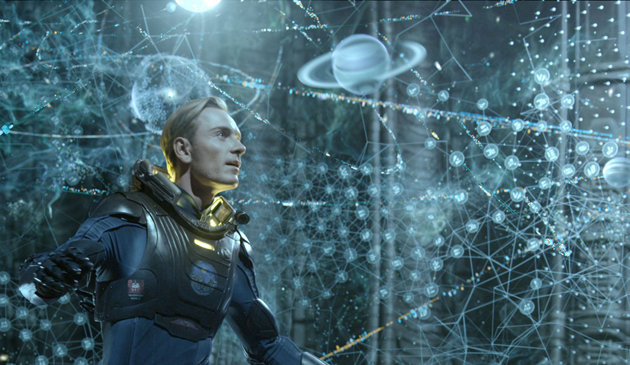
Prometheus Review


Prometheus
Directed by Ridley Scott
Released in 2012

Is there a god? Does god hate us? What is god? Is Michael Fassbender god? Prometheus asks all of these eternal questions, pondering with a grandiosity now only seen in vapid summer movies. It is easy to admire Prometheus for what it dares to accomplish. In the same breath, it is easy to dislike the film for supplanting the wonder of these unanswerable questions by setting up answers and, naturally, botching their delivery. The film believes it is smarter than it truly is, meaning that it believes it is smarter than us. Prometheus buckles under the weight of its own mangled but beautiful ambition.

The plot behind Ridley Scott’s “space epic” has been kept under wraps, or so they say. The stirring trailer, replete with those Alien wails and stroboscopic cuts to black, actually reveals most of the movie. Not in context, of course, but the most memorable images of the film’s latter half are already in the marketing campaign. It is a mixed blessing that the images in the trailer are so captivating that it is hard to forget them.


Prometheus opens with the inception of life on Earth. The theory proposed is a rather clumsy variation of panspermia, wherein life originates from elsewhere in the universe. The first shots are beautiful, not unlike some of The Tree of Life’s stellar second unit work. Fast-forward so many years to 2089, where scientists Elizabeth Shaw (Noomi Rapace) and Charlie Holloway (Logan Marshall-Green) are searching caves on Scotland’s Isle of Skye for paintings that carry extraterrestrial secrets, pointing to life in the distant stars. Boring. Snap to the spacecraft Prometheus four years later, where Shaw and Holloway awake from stasis alongside a collection of mercenaries and scientists. There is that initial crew dinner scene you have seen in Aliens, Star Trek and every other sci-fi ‘space soldier’ flick, except the jokes fall flat. There are two knuckleheads, Millburn (Rafe Spall) and Fifield (Sean Harris), both poorly written and supplied weak banter. You know what is going to happen to their characters; you do not protest.


The mission at hand is to land on the moon LV-223 and see if these aliens were even there at all and why. They were there, of course. These proto-human “Engineers” manufactured a base on this moon long ago and … it is best to let the film tell the rest.


Dialogue is the obvious misstep. The most memorable line from the film is one from another. Android David (a wonderful, Bowie-esque Michael Fassbender) occupies part of his time on the ship watching Lawrence of Arabia and even styled his hair after Peter O. Toole’s. Before stepping onto the alien surface, he repeats the haunting quote, “There is nothing in the desert and no man needs nothing.” To be fair, it is tough to beat that. But the lack of humor (a memorable aspect of Aliens) and perceptive discourse (in a film with such ideas) is what will keep an audience five or 50 years later from connecting with a film so graphically dependent.


There is one laughable scene when Janek (Idris Elba), the ship’s callous pilot, runs into a room where Shaw is suiting up for the final mission. He lists a number of crucial details regarding the Engineers that he would have no way of knowing. It is a lazy excuse to advance the story and a screenwriting blunder.


The problem with Prometheus comes down to the way it chooses to tell its story. Clearly, it is an action-adventure film, and a pretty good one at that. Scott stages compelling entertainment. Older audiences tired of the politically correct PG-13 blockbuster standard will find a violent spectacle with production values normally reserved for safe bets like Avatar. The visual team crafts some of cinema’s most sweeping and striking moving images. A shot of the Prometheus gliding across the stars and another dwarfing the ship against the moon affirms the movie’s epic scope, an inverse of the slow pan over the Nostromo that commenced the self-contained Alien.

Scott sees this as his 2001: A Space Odyssey, which the opening shot of a shadowed Earth not too subtly suggests. Communication breaks down, however, when addressing philosophical questions about god, man’s purpose and the Copernican principle within a generic action movie structure. The film’s climax could carry a sense of wonder — without spoiling much, it relates to a “first contact” with superior beings. Instead, it is an action scene with nothing to say. Not ‘nothing’ in the nihilistic sense, nor even an ambiguous, interpretative one. Prometheus just botches the landing, feeling limp and disconnected.

Take the film’s half-baked commentary on religion. Deeply pious, Shaw demands her cross back after it was confiscated. Bombarded with death and destruction, she still insists on believing simply to put a positive spin on all this tragedy. There are plenty of critiques of religion at hand, from the Engineer’s dark plans for mankind to expedition CEO Peter Weyland’s (Guy Pearce) god complex. To balance the debate, a religious protagonist is thrown in, but she comes across as naïve and senseless. Maybe that is the point. In any case, Shaw is either an incomplete character or a degrading attack on faith. I'm not sure which one is worse.

I levy these criticisms only because the filmmakers have brought these expectations upon themselves. Once upon a time, madmen like Francis Ford Coppola and Stanley Kubrick were granted millions to create intellectual epics like Apocalypse Now and 2001. Ridley Scott was one of those crazies, as Blade Runner was made under similar circumstances. You do not see cinema of that ambition and allowance today.

Final Verdict:
3 Stars Out of 5


This article was originally written for The Cornell Daily Sun and can be viewed at its original location via this link.

Sunday, June 10, 2012

Alien

This is the first post in Film Stock, a series of reviews appreciating the greatest films of all time. In the spirit of the just-released Prometheus, inaugurating this collection is Ridley Scott’s 1979 opus, Alien. A choice like Casablanca would be more classical and an essay on The Tree of Life would appear more legitimate, but I would like to start with a film that is a masterpiece by all accounts yet also thrilling entertainment and a hallmark in modern moviemaking. Film Stock will update periodically, as per my schedule (I don’t get paid for this, after all). The criterion for a film selected is at least two (often more) viewings several months (often years) apart. I aim to cover a wide range of film history. To prove this, no Christopher Nolan … for now.


Alien
Directed by Ridley Scott
Released in 1979

What I would give to know nothing of Alien and watch it again for the first time. Unfortunately, that can never happen. I imagine few people are out there [reading this] who do not know that scene — that scene, when the whole movie changes. If you have no idea what I am getting at, by all means stop reading this and watch this movie untarnished while you still can. But for the rest of us, the alien — later labeled “xenomorph” — and its gruesome method of reproduction are as close to public domain as R-rated science fiction can reach. There is no scene in film history with such an unexpected punch. Psycho’s shower scene. “You’re gonna need a bigger boat.” “Nobody’s perfect!” Alien’s Last Supper owns it.

It speaks to Ridley Scott’s brilliance, then, as to why watching Alien for the third time the other day, with the same foreknowledge of the twist as my first viewing, remained as shocking as ever. For that infamous dinner scene, in particular, the suspense relies mostly on the framing of the shots. Scott does not rely on quick cuts to artificially escalate tension; he sustains a shot on Parker (Yaphet Kotto), Dallas (Tom Skerrit) and the ill-fated Kane (John Hurt, perfect as always), only to cut to his friends dining around him. None of them realize what is really happening until it happens, or even after. The characters are not fleshed-out to the extent of a character study a la Raging Bull, but the agonizing, sustained duration with which Scott forces us to watch Kane’s brutal demise, and his friends struggling to save him, defines corporeal and emotional pain.

Consider that it takes about an hour to reach this point. It is a horror movie, and there is not a drop of blood until it is halfway done, and truthfully not much after that. As the alien picks off the remaining crewmembers, most of the deaths are depicted off-screen (shadows against a cat’s head, for instance) or through rapid, almost subliminal shots of gore (usually the alien’s phallic inner mouth pulverizing a head). One of the most notorious jump scares in film history — Dallas’ trek through the ventilation system — is also one of its most craftiest, fooling the viewer with a tracking shot that focuses on the foreground, only for Dallas to illuminate the background with his flashlight and *!!!* *static*. Scott tells the story from the parceled viewpoints of the Nostromo’s inhabitants, only quickly cutting when a vantage point, no, when a friend, has been terminated. The steady pacing, before, during and after duress, is the film’s secret weapon, acclimating the audience to the ship’s confines and acquainting us with our fellow humans, who we are powerless to save. We just watch. Or don’t.

With Sigourney Weaver’s prolific acting schedule in the many years since this film, often starring as a yappy bureaucrat or fast-talking heroine, it is easy to forget this understated performance in her first leading role. Aliens would give her more lines and cement Ripley as the quintessential female action hero. But here Weaver tackles the part without any camp, transcending the admirable benchmark Jamie Lee Curtis set in Halloween two years earlier. Scott certainly dreamed of greatness for Alien, but his dreams only came true with Weaver’s talent and willingness to break ground beside him.

What a remarkable character they created. Ripley revolutionized Hollywood and all those who watched and continue to watch her. Without Alien, we may not have ever seen Clarice Starling, Sarah Connor or Beatrix Kiddo.

Here was a woman, beautiful she may be, not typecast as the clueless female caricature awai
ting her male savior. She organically takes charge above her peers, each of whom could surely do the same (except Brett (Harry Dean Stanton) … poor Brett). But only Ripley had the foresight of the fatal contamination Kane’s alien contact would wreck and the strength to persist with such a tough verdict, even if the literally corrupt Ash (Ian Holm) bypassed her wishes. And only Ripley made it to the end, not by superiority or radical political correctness, but because she was coarse enough to think like the alien and take the bitch out herself.

Some fem
inists decried the sexualization of Ripley once aboard the escape vessel, when she takes off her clothes aboard the escape vessel she believes is safe. “Stripping her narrative competence with her uniform,” Vivian Sobchack writes in Alien Zone, a collection of essays on science fiction cultural theory, “Ripley no longer represents a rational and axesual functioning subject, but an irrational, potent, sexual object — a woman, the truly threatening alien generally repressed by the male-conceived and dominated genre.” Whoa now. Sobchack makes a good point on the ‘uncovering,’ be it will, of the true woman, who is also alone and captured in low, voyeuristic camera angles. But she does not see the true critique and brilliance of the sequence, where Ripley must adorn the spacesuit no woman had worn to the point, become the ‘man’ and kill the hermaphroditic male rapist for good. 

With such subtle imagery, Scott is not substituting Ripley for a male surrogate to win the day but thrashing the expectations the sci-fi audience already conceived for her character. The littl
e striptease is almost sinister in its intention: For the first time, the film incites cheap arousal from the predominantly male voyeurs yet then reintroduces the sexually relative monster and robes Ripley in men’s clothing for a bloodless finish. Scott’s provocation makes for the most satisfying unsatisfying climax in thriller history, no pun intended.

Someone with a familiarity in art history, design and sculpture could speak in more impressive terms, but as a construction leader of my high school production, I know the work it takes to create a set and Alien’s little world is a fully realized, nuanced masterpiece of the craft. The utilitarian hallways Ripley sprints down, with their monotonous pipes and wires that run in stark contrast to Star Trek’s primary colors. The stark geodesic bubble where crewmembers access the ship’s computer, Mother. The resistance of the failsafe levers that Ripley fails to overcome in time. Overwhelming with detail, the Nostromo’s design stands an unparalleled achievement in art direction to this day. Scott, who had a hand in the visual design with Roger Christian, Leslie Dilley, Stan Winston and the essential H.R. Giger, makes love to the set with his camera. Every scene captures an area of the ship from a new viewpoint. The lens flare illuminating the crew during the ship’s descent likely inspired J.J. Abrams. It is a grimy, empty, dreary ship, yet never a depressing or boring view.

There is a complete universe inside and outside the Nostromo. Today, that means “sequels!” and it did in 1979, too, as three successors bore the Alien name over the next 18 years. While James Cameron’s Aliens remains one of his greatest accomplishments (among many, I should clarify), it is a decidedly different film, expanding the mythos while losing its mystery. Meanwhile, the final two films fumble a little too much with their legacy. Alien, Ridley Scott’s perfect film, one with Jaws and Psycho, transcends its genre with multiple levels of meaning on image and soundtrack. Like Spielberg and Hitchcock’s best, the thrills survive without attention to its politics or ideology or aesthetics. But they are all there, ripe for discovery upon each viewing, dealing naked thrills and scary truths.