Friday, November 15, 2013

12 Years a Slave Review

12 Years a Slave
Directed by Steve McQueen
Released in 2013

Think back to elementary and high school, when you learned about American slavery as a young student. A chalkboard or PowerPoint slide relayed statistics of the Triangle Trade. You paid attention to key words and concepts that might appear on next day’s fill-in-the-blank quiz. Your life was comfortable enough that this grade seemed to be the only thing at stake. And that was that.

With blunt force, 12 Years a Slave reminds us that embalmed, quasi-objective summaries of America’s greatest shame do not approach anything close to knowledge. For in this draining but necessary new film, history informs art, but it is art that realizes history. Like Steven Spielberg with Schindler’s List, director Steve McQueen knows that only emotion and, more precisely, pain, convey the true toll of our violent, oft-romanticized past. While you may feel battered around taking in McQueen’s manipulative, unapologetic style of filmmaking, you should also leave the theater grateful. At last, you have witnessed an image of slavery both lucid — for, like most Hollywood pictures, it follows one man and his struggle — and unflinchingly, savagely honest.

Our eyes into history belong to the incredible Solomon Northup (Chiwetel Ejiofor). Based on the life and memoir of a freeman-turned-slave of the same name, 12 Years a Slave opens on a plantation where a dejected, much older Solomon hacks away, like a machine, at sugar cane before flashing back to an idyllic suburban family portrait in Saratoga Springs, New York, circa 1841. A gifted carpenter and violinist who has won the favor of the town’s wealthy white folks and its remarkably progressive shopkeeper, Solomon lives a pretty modern life with his wife, daughter and son. Enter Scoot McNairy and SNL’s Taran Killam as two genteel traveling musicians who look like the Mad Hatter and recruit Solomon’s skills for a tour to Washington D.C. After a night where his hosts made sure his wine glass was always filled to the brim, Solomon wakes up on the floor of a dungeon, in rags and chains. A walloping from a studded paddle and the words, “You ain’t a free man,” welcome Solomon to hell.

If you would allow me the digression, I would like to look closer at that turning point of a scene, when Solomon gets beaten. In the first long take and off-putting composition in a film full with them, McQueen and cinematographer Sean Bobbitt spread Solomon across the foreground of the shot, on his hands and knees, as a white man, out-of-focus in the background, enforces blows to his back. Solomon screams in agony with every strike, but shadows shroud his contorted face. So, what do we have? Solomon, the white man and the weapon are all obscured or distorted from our sight in some way, yet the iconography of a slave receiving punishment, from Solomon’s supplicant pose to the abstracted colors of both faces, is unmistakable. In this shot, Solomon stands in for any and all slaves, suffering not just bodily harm but the first pangs of becoming something less than a person.

From this shot onward, McQueen and screenwriter John Ridley balance the two conflicting duties when depicting slavery: humanize your lead subject (here, Solomon) but do not elevate him above the millions of others unable to tell their own story. While Solomon is more educated and well-spoken than most of his fellow slaves, he realizes he must play dumb if he wants to survive in a white man’s world (not unlike Forrest Whitaker’s adaptive servant in Lee Daniels’ The Butler). Slavers look for obedience to match a slave’s muscles — anything more stirs revolt. Notice the sickening compliments a slaver (Paul Giamatti) showers over the naked black men and women standing frozen like mannequins at auction, rapping a man’s toned chest and lifting a girl’s smooth chin, with awful insinuations. He sells Solomon, now known as “Platt,” and a mother (Adepero Oduye) to Ford (Benedict Cumberbatch), denying Ford’s half-hearted attempt to appease the mother’s cries to buy her children too. Not the son, the slaver whispers with glee, because “he will grow into a fine young beast,” and not the prepubescent daughter, because give her time and, well …

If the slaver’s inhumanity brings out the gentleness in Ford’s disposition, the scene also reinforces that Ford perpetuates this system with a bundle of cash. After Ford gifts Solomon a violin for good behavior, the lamenting mother makes sure Solomon doesn’t forget that, “given the circumstances,” Ford is still a slave owner. And after Solomon assaults a sadistic overseer (Paul Dano, who, after Prisoners and There Will Be Blood seems to be Hollywood’s go-to punching bag), Ford whisks his property away to Edwin Epps (Michael Fassbender), infamous for “breaking” his slaves. By the way, this is immediately after Solomon survives a daylong lynching by tiptoeing in the mud, which McQueen films for a suffocating, unbroken eternity.

It is at Epps’ cotton plantation where the majority of the film remains, where Solomon befriends a doomed, kind soul named Patsey (Lupita Nyong’o) and completes a transformation of his own. Patsey has earned the bad fortune of Epps’ lust, and thus also his wife Mary’s (Sarah Paulson) cold-eyed contempt. The scenes between Patsey and the two Epps bring out a savagery in the so-called civilized white men and women who believe they have a biological mandate to own “inferior” humans. Thankfully, Patsey has Solomon, who has wised up to the dehumanized submission survival requires. This leads to a horrible, albeit cinematically extraordinary scene filmed in nauseating handheld, akin to Gaspar Noé’s Irréversible. Not long after, Solomon resolves his guilt and accepts his sorry state in another perfect long take, filmed in tight close-up, where he hesitates before joining in on a graveside Negro spiritual. The internal strife Ejiofor communicates with just his eyes — looking up to God, down to the dirt and, finally, forward ahead — pretty much grasps 12 Years a Slave from McQueen’s hands.

Like Schindler’s List before it, 12 Years a Slave concedes to a fair dose of Hollywood sheen. Mary Epps is so evil she’s lifeless. Hans Zimmer’s score, while effective, reuses Inception’s “Time” motif (which he, in turn, adopted from his Thin Red Line soundtrack). The 134-minute running time almost feels too short, stretching the believability that Solomon’s journey spans 12 years. Brad Pitt shows up near the end, to distracting effect. But if Pitt’s name sells one or 1,000,000 more tickets to see this film, I am on board. For once, a gimme-Oscar pitch has earned its merit through artistry and provocation. You won’t remember the lashings as much as those despairing human faces. Those you won’t forget.

Final Verdict:
4.5 Stars Out of 5

This article was written for The Cornell Daily Sun and can be viewed at its original location via this link.

Wednesday, November 13, 2013

The Big Question

INT. PSYCHIATRIST OFFICE — DAY

Dr. Frank: What are you doing?
Zach: [sits up on chaise lounge] I’m right here?
Dr. Frank: No, I mean at school … as you were saying.
Zach: Oh. Well, I have my classes, five of them right now. Lot of work with those, but they’re like Film and English so I can’t complain. [beat] And I write for the newspaper, The Daily Sun. I write for the Arts section: you know, movie reviews, concert write-ups, columns, pretty much anything on Breaking Bad. I’ve had a few cool interviews, too. Do you know A.O. Scott?
Dr. Frank: Zach, look out my window.
Zach: Okay.
Dr. Frank: What do you see?
Zach: Central Park?
Dr. Frank: Yes. I know who A.O. Scott is.
Zach: Okay. [looks at hands] Well, I’m glad I talked to him. This was last week. Being a movie critic for The New York Times, that’s a great job.

Dr. Frank: What do you want to do with your life?
Zach: Oh, geez. There it is…
Dr. Frank: It’s the big question.
Zach: Yeah, I mean, sometimes it keeps me up at night. Like I said, I love film. I want to do something in that field.
Dr. Frank: In what capacity?
Zach: That’s the big question. I would love to direct, write or produce, or even edit. I’m not terribly confident in any of those — like, so much of directing and producing remains a mystery to me — but I appreciate that you can collaborate with so many other talented people to get one big project done. I’d love to give all that a shot. It’s just…
Dr. Frank: Hmm?
Zach: You know. I see where you’re going with this. You just asked me what I’m doing, currently, and then you ask me what I want to do with my life.
Dr. Frank: And?
Zach: And there’s not a whole lot of overlap between the two. Right?

Dr. Frank: I didn’t say that.
Zach: Well, I took a screenwriting course last semester. I’m in a filmmaking class now. I didn’t mention that before.
Dr. Frank: Hmm.
Zach: They’re not easy. I mean, I’m doing fine, grade-wise, but I am starting to realize how really good you have to be to make a living as a director, screenwriter, you know.
Dr. Frank: Good?
Zach: Well, maybe “good” isn’t the word. You have to be persistent. Like, just adamant about being a filmmaker and not giving up, always adapting. That’s what John Krokidas told me. He directed the movie, Kill Your Darlings, with Daniel Radcliffe, Harry Potter, in it. Have you heard of it? [cranes head backwards]
Dr. Frank: [scribbles in notebook]
Zach: [settles in again] You just have to really want it. I’m not sure I really, really want it. Am I willing to fight for it? I don’t know. [beat] Besides, I’m a ways away from being good enough. I have a lot more messing up to do before I’m ready for the big leagues. And, even then, I don’t know if I ever will be…

Dr. Frank: [raises head] I would like you to consider my first question again.
Zach: How am I today? Well, I’m here, Doc, clearly I could be better.
Dr. Frank: No, Zach, I mean the question that started this dialogue of ours. What are you doing now that you excel in?
Zach: [exhales] It’s tough to say.
Dr. Frank: I don’t think it is.
Zach: What you getting at?
Dr. Frank: You talk about wanting to be a film director or editor but you keep returning to the work you do currently, the writing you do for The Sun.
Zach: Yeah, I guess so. It’s a big thing I do.
Dr. Frank: Please elaborate.
Zach: Well, I enjoy it — to an extent. There are many pieces I’ve written that I totally disown. Sometimes they’re bland or too abstract, or sometimes I take some stupid idea I thought was novel and extend it too far. [beat] But there are pieces of mine I am proud of. Some of them have a sense of voice and conviction. To be a good critic, you need those things.

Dr. Frank: It sounds like you have had time at school to err in your writing and get better doing so.
Zach: Yeah, that’s right. It takes time, doesn’t it?
Dr. Frank: To sit here, with you, today: 14 years of studies, after high school.
Zach: Man, that’s right. Wow. What better time to mess up than at college? [cranes head again]
Dr. Frank: This is your hour, not mine. Please continue.
Zach: Yes, okay. I’m just realizing now that I’ve started on a path of journalism, and that I’ve made some headway. I think I have. To really excel in filmmaking would require starting from scratch, on a different path, which I have begun to do. But it’s tough, and I’m not sure if it’s for me. [beat] Plus, I believe great criticism is an art of its own. Don’t you agree?

Dr. Frank: [wistfully] I was a film critic for The Crimson, long before you were born.
Zach: Awesome! [coughs] Well, any advice? What path should I take?
Dr. Frank: All yours to decide. [looks at watch, slams notebook shut] Look at that, our hour is up. Same time next week?
Zach: Ah… [lies rigid on couch]
Dr. Frank: [walks to door, opens it]
Zach: Alright! [bolts up and out toward the door] Sure thing, Doc. Same time next week.

Dr. Frank: Be sure to see Diane on your way out. The month’s bill is due. [slams door shut]

This article was written for The Cornell Daily Sun and can be viewed at its original location via this link.

Monday, November 11, 2013

Elvis Costello Concert Review

Elvis Costello
At State Theatre, Ithaca, N.Y.
On Thursday, November 7, 2013


There is an awesome dissonance to Elvis Costello’s genius: He’s got that voice, as recognizable as David Bowie’s or Van Morrison’s (if you think about it, it pretty much sounds like a marriage of the two) that has hardly changed after  more than 40 years of belting. But then you’ve got his actual music — 32 studio albums worth, kicking off with radio-friendly punk before spiraling into soul, country, folk, electronica, jazz and classical. Hell, he made an album with The Roots this year. The word “chameleon” is often used to describe Costello, and rightly so, yet he’s the same guy, with the same voice, the same glasses, the trademark suits and fedoras. If there is any venue in Ithaca where time can, for a little over two hours, at least, slow down and where the man himself can open up, it is our very own State Theatre, where Costello played a solo set Thursday night courtesy of Dan Smalls Presents. Turns out Elvis Costello is not only a virtuosic performer but also a gracious, funny guy eager to look back on his roots, music history and the popular enigma he has erected in his name.

A jumbo-sized “On Air” sign idled by stage right before the show began. There was little other ornamentation up there, save for an intimidating number of guitars (I counted five). My eyes wandered over the State Theatre’s walls, ceilings and lamps, soaking in their history. Not long after a beaming Costello, sans opener, took the stage at 8 p.m. and the “On Air” sign lit up, he made sure to applaud his surroundings. “I’m making an effort to play all the old vaudeville theaters,” he said humbly, reminiscing about when he first visited America and made sure to see all the monuments: “The St. Louis Arch, the Empire State Building … and Ithaca.” “Rock and roll was invented here in Ithaca, you know,” he quipped later in the night, “concocted in a science lab here in Cornell, before anyone wanted it.” A genuine appreciation for our town and his audience buoyed any dry sarcasm, which could explain why this sold-out crowd greeted every song with some of the loudest, most passionate ovations I have ever heard.

He earned it. From the first song, My Aim Is True’s “Welcome to Working Week,” Costello radiated excitement. On “King Horse,” he toyed with pedal reverb and stuck all the requisite high notes and then some. His voice held strong to the end, although he called on audience participation now and then. At times, the call-and-response echoed the scatting of Cab Calloway — as during his performance of “America Without Tears,” where he approached something like delirium with complicated doo-wop and trills. When covering The Beatles’ “You’ve Got to Hide Your Love Away,” he egged everyone on to really shout the “Hey!” that precedes the eponymous chorus — he seemed so happy to perform a song he has clearly loved since childhood. Just to balance the mood, perhaps, he got the crowd to reiterate, “Now I’m dead … I was scared,” a bunch of times in “God’s Comic.” This call-and-response got louder and louder and, by song’s end, felt more cathartic than macabre.

If the back-and-forth is any indication, Costello hosted an atypically intimate night of music and chatting about music. “This is a socio-political survey,” he announced early on, “about the last [50 to 70 years] of history and my place in it.” A proven legend like Elvis Costello can spout as many self-aggrandizing boasts as he wants, as far I’m concerned, yet this quote turned out to be a wordy precursor to a selfless and sentimental examination of his family and influences. In between a Nat King Cole cover, “Walkin’ My Baby Back Home,” and “Ghost Train,” he joked about his late father, a musician who “looked like a hippie” or Peter Sellers fromWhat’s New Pussycat? (think Velma from Scooby Doo). His dad once booked him a gig as a backup guitarist before he even knew how to play. Costello improvised, going crazy on air guitar to the befuddlement of his older audience. He actually learned how to play guitar, of course, and, in those Born to Run days, he wanted nothing more than to be Bruce Springsteen. This idealism produced “Radio Soul,” a highlight of the evening and a much more romantic precursor to the scathing hit “Radio Radio.” This reflection granted Costello an opportunity to weigh in on the power of music, which he believes mixes internal emotions with the drama of melody and dynamics to create something uniquely empathetic. Given the evidence, I don’t think he could find one naysayer for miles around.

When his narrative arrived at his grandfather, Costello worked the audience like a seasoned comic, with speculation about how his ancestor was too “finely dressed” for a trumpet player: he must have been a smuggler, too. This levity segued into talk of the Great Depression and “Jimmie Standing in the Rain,” the strongest and most heartrending song of the night. The ache of his voice as he sang that borrowed last line, “I’m your pal/Brother, can you spare me a dime?” away from his microphone lingered in the air before being swept up by exuberant cheers from every soul in attendance. A similar vibe informed “Alison,” which he sang with little movement and his hat tilted down. He hushed his guitar to let his melismatic vocals take over. In such a charged, nostalgic atmosphere, that oft-repeated line, “I’m not gonna get too sentimental …” revealed its true colors.

By the second encore (thats right, second), Costello took requests with a loud, red, light-up “Requests” sign. A tender rendition of “Tripwire” on electric guitar morphed into a wild “(What’s So Funny ’bout) Peace, Love and Understanding,” which ended in a carnal loop of guitar feedback. Costello met multiple standing ovations with a bow and quick retreat back to the guitar or, by the end, keyboard, holding a finger up in the hair to indicate “Just one more.” He actually followed up with two more, ending on the somber ballad “The Puppet Has Cut His Strings,” which reaffirmed worked more to reaffirm the pathos of the second-act songs than the comic, pub-like feel of the first act. We got close to the man, we laughed with him, we exchanged compliments. By the end, that internal artistry reclaimed its hold, bringing the mood down while keeping our spirits high. Elvis Costello shared something special with us Thursday, something complete. But he, like every true genius, left the stage a puzzle unsolved.

This article was written for The Cornell Daily Sun and can be viewed at its original location via this link.

Wednesday, October 30, 2013

Here's to You, Lou

Courtesy of Santi Slade and Zander Abranowicz
There is a point in every music lover’s life when things get ugly. Dissonance, atonality and heavy, dirty subject matter assault your ears and your precious illusion that all music is supposed to sound nice and pretty and easy to dance to. It’s how you react to this challenging aesthetic that defines your relationship with music: Stick with the old for the comfort you see as its mission to provide, or sneak toward this abrasive yet alluring New?

More than anyone over the past half century, Lou Reed, who passed away Sunday at the too-young age of 71 years, turned us onto this other side of music. Before him stands Schoenberg and Stravinsky, and in his wake, we have Johnny Rotten and Tom Waits. Sometimes I would rather listen to Waits than The Velvet Underground, the immortal rock band Reed fronted with John Cale, Sterling Morrison and Maureen Tucker. Hell, most of the time I’d take “Wouldn’t It Be Nice” or “Get Lucky” over the both of them. But I love Lou Reed most of all for exposing me and so many others to music’s oft-guarded potential as art, and for making that discovery so immediate, delirious and fun.

It was mid-2006. My family had lived in Weston, a suburb of Fort Lauderdale, for about a year, with the three-part crescendo of Hurricanes Dennis, Katrina and Wilma still on our minds. Put it on our storm shutters, luck or my privileged naivety, but the storms didn’t bother me too much. In fact, they brought on a sort of rush, an awareness of the world’s capabilities for entropic destruction cushioned by the sense that this awareness was always on the cusp of my knowing. In some perverse way, bearing first-hand witness to nature’s fiercest work affirmed a long-dormant feeling that the world was unpredictable and strong and violent. It was the perfect time to discover The Velvet Underground.

Rolling Stone had recently republished “The 500 Greatest Albums of All Time” in book form, and for all the complaints I charge that list with today (No Pixies or Radiohead in the Top 100? No Guided by Voices at all?), it was a perfect primer for middle school me. Before I flipped to Captain Beefheart’s Trout Mask Replica, what caught my eye was Andy Warhol’s taunting cover art for The Velvet Underground & Nico. “The Velvet Underground … ‘heroin’ … hmmm … this does not look like it should have a banana on it.” And so the art of irony entered my life, where it has stayed. When I biked over to the library to check out this album and burn it on my dad’s computer — six stars, GTA-style — I was riding some waves, let me tell you. All that before I even listened to a song.

What can I say about the music? It threw me off, at first, as the delicate xylophone from “Sunday Morning” came in and I thought, shit, this might actually be some kiddie music with a stupid banana on it. But if The Velvet Underground teaches you anything, it teaches you patience: just relax, the music will sort itself out and, if it doesn’t, you better sort yourself out, man. Layers of instruments and reverb coat this psychedelic track, lulling you into comfy complacency until — DA DA DA DA DA DA DA DA DA DA DA DA DA DA DA DA. Are those pianos? Really? I’ve heard of the Wall of Sound but this thing is a freight train. The aggressive opening to “I’m Waiting for the Man” throws you for a loop before Reed’s unflappable voice comes in, as he sings about the “26 dollars in my hand” to buy smack from an “always late” dealer who “wore shoes and a big straw hat.” What a delicious look at the grit of not just drugs but of the New York from Midnight Cowboy. Reed embodied in his fashion, character and art the spirit of Gotham you can’t touch today. Bless Laurie Anderson — Reed’s wife and a respected artist of her own — for sticking with him.

His music felt too close for comfort, as if it violated your conceptions of how the medium that gave us Schubert’s “Ave Maria” was supposed to work. It’s life-changing stuff. “Heroin,” the centerpiece on The Velvet Underground & Nico, slunk in and scratched at my core. Here is a song that lets melody drop in and out, fall out of sync with rhythm and just push ahead into pure chaos. It hits you in the gut with lived-in experience, with the sensations of heroin use that Reed and Cale were gracious enough to convey through music so some suburban kid can hear and feel how the other half lives (I don’t think that was their intention). Reed’s cool “Ha!” after “When the heroin is in my blood” in the last verse always haunted me the most, as I realized that this was not some P.S.A. about the ills of drugs. He let us know he enjoyed what he did, even as it ravaged him with the fury of Cale’s screeching electric viola.

To rattle off a few other Reed masterpieces: “White Light/White Heat,” which presaged The Stooges and all of punk; “Sister Ray,” a 17-minute opus where organ solos sound like amp feedback and vice versa; “Sweet Jane,” where, out of nowhere, he sexes up the bourgeoisie; “Walk on the Wild Side,” a sparse, spacy ditty that sounds to me like what e.e. cummings would make if he was a rock star; “Satellite of Love,” where he recognizes his voice is so smooth that he pretty much just talks the lyrics, leaving David Bowie to do the belting. Then you have Berlin, a rough, sad rock opera that has long fought for recognition; Metal Machine Music, over an hour of just noise; and Lulu, his loathsome collaboration with Metallica, where you can hardly hear his voice.

Lou Reed may not have been at the peak of his career when he passed but I always loved how he still managed to so relentlessly troll the scene. He was pure id, although he sure had one big ego. “It’s maybe the best thing done by anyone, ever. It could create another planetary system. I’m not joking, and I’m not being egotistical,” Reed said in regards to Lulu.


What an asshole. But we nearly bought it, now didn’t we? After all, he promised nothing that he did not already deliver before.

This article was written for The Cornell Daily Sun and can be viewed at its original location via this link.

Wednesday, October 16, 2013

The Filthy, Brilliant Back Alleys of Twitter

Facebook and Twitter. Say it out loud: Facebook and Twitter. Twitter and Facebook. Status updates, news feeds, retweets, social media ... There was once a time when these words had a spark of potency to them, before Buzzfeed, IPOs and the Fox News Deck. We too easily conflate Facebook with Twitter, or at least bunch them together in the same headline (“The Anti-Social Social Network??”). But while Facebook deserves censure for its ever-growing string of privacy concerns and unwavering intellectual vacuity, Twitter is too rarely celebrated for what it has revealed itself to be: A platform for a new, bizarre and brilliant form of literature.

Granted, if you just follow your friends, One Direction fans and celebrity “parody” accounts (“FillWerrell” is the worst), you have yet to leave the Facebook ghetto, or are stuck on an even more insipid avenue all your own. Of course, many of my friends at Cornell and back home maintain honest and entertaining Twitter accounts — that goes without saying. They join the wider band of users I follow, and not the other way around. Aside my friends’ often very earnest updates (usually about appreciating life, weather, etc., or stressing over work), I find the topical, capsuled comedy of Stephen Colbert, the metropolitan musings of Ezra Koenig, the inspiring cinephilia of Richard Brody, the gaming know-all of Jeff Gerstmann and the “weird, sexual, anti-comedy comedy” of Megan Amram.

It’s that last one that I would like to talk about. Amram’s off-kilter brand of humor caught my eye early on (I’ve had a Twitter since 2009, which is apparently a long time). From “Anyone who doesn’t request unlimited salad and breadsticks as their last meal is an idiot” to “Guys be honest how raven am I,” her style is about one part removed from the typical stand-up one-liner, and mostly in step with the alternative comedy sensibility practiced by Zach Galifianakis, who also once teased the grammar of That’s So Raven in his set. She landed a writing gig on Parks and Recreation from the strength of her tweets, which feed off millennial references and ironic turns of phrase to appeal to a predominantly college-aged demographic.

Amram still deserves to be ranked with the best of Twitter today, yet it is down the back alleys leading from her work where you can find the most ingenious and subversive comics on the web. An acquaintance from my early high school gaming days, @piss_wizard posts like crazy (he broached 97,000 tweets recently) on anything that passes his mind, from the crappy politics of his native U.K. and the U.S. to delirious pop culture mash-ups like “banjo kazooey deschanel.” This mad stream-of-consciousness approach to tweeting finds seasoned practitioners in @othersome and @jitka, as well. On fleeting occasions, I have interacted with these accounts and have found them to be smart, unusually self-aware young guys (one of them is a Cornell alum) who circumvent the corporate political correctness of Twitter by trolling it with apolitical, stupidly funny non sequitirs. “@tomhanks happy hanksgiving,” read an @othersome tweet you know he waited weeks until Thanksgiving to send, while @piss_wizard tweeted to the Pope, “@Pontifex when is half life 3 coming out.” And when the cool mode of irony doesn’t suit the occasion, a concise though fervent rant will do, as @jitka made clear early last year: “shut up about bacon. bacon is good but just shut up about it already please. it's just bacon. it's literally just bacon”

You may notice the lack of proper capitalization, punctuation and spelling in these tweets, which is about an aesthetic requirement for this school of humor. Some bloggers have referred to this body of jokesters as “Weird Twitter,” which I guess is about the right name if you had to pick one. But while the tweets may look similarly ‘broken,’ it must be emphasized that “Weird Twitter” is a simple label for a very diverse pool of comedy. Some of these masters exclaim all-caps epiphanies (@rare_basement: IMAGINE IF JAMES JOYCE COULD SEXT) while others impart narrative poetry so subtle they should be considered [hilarious] works of art (@UtilityLimb: it's sad thinking of all the dogs in old movies that have died, but even sadder thinking of the earth we fled because of the dogs that can't”). Some make light of (and truly love) gaming culture (@wolfpupy: burn your enemies and take the gems they drop) while others prefer to riff on film or music, like @ingmarbirdman or The Mountain Goats’ own John Darnielle, who I consider an honorary member of Weird Twitter, with his standout contribution: “When my Citizen Kane moment comes I’m pretty sure I’m gonna say ‘Nerds Rope.’” Like I said, millennial humor, even for a 46-year-old man.

Weird Twitter (not a phrase I love, but it’s easy shorthand) works so beautifully because it recognizes that the utopian pitch for Twitter, and all social networks, to make the world a more connected, knowledgeable place is B.S. Twitter secured its staying power once WalMart realized it could sell more stuff with this thing. With that acute awareness of how the Internet, and thus the 21st century, works, this ragged band of comics spews both its jaded contempt and sincere awe for the world around at or under 140 characters apiece. Ironically, doing so has fulfilled the site’s idealistic goal and united these provocateurs as they stake out a new avant-garde form of Twitter-based comedy. Leave it to @dril — a cross between Bukowski and 4Chan, and surely the greatest Twitterer today — to sum up the profound and irreverent grace of the medium: “sometimes i gaze towards the beautiful endless sky and wish that i was a bird. so that i could piss and shit out of the same hole.”

This article was originally written for The Cornell Daily Sun and can be viewed at its original location via this link.

Sunday, October 13, 2013

Decasia & Just Ancient Loops Review

Decasia
Released in 2002
Just Ancient Loops
Released in 2012
Directed by Bill Morrison

What a pretty mess.

Whatever your feelings on Bill Morrison’s Decasia and Just Ancient Loops, two experimental films Cornell Cinema screened at Sage Chapel Tuesday evening, you should agree that this pithy assessment of mine approaches some objective, albeit cursory, truth. For Morrison’s work discovers a beauty in what most would consider ugly, nonnegotiable trash: destroyed and/or decomposing celluloid film stock from the ancient, lesser-known annals of silent cinema. By assembling these clips together and asking us to find meaning in their perceived deficiencies, Morrison works in a most peculiar mode of the “found footage” form. These decrepit moving images take on new life, paradoxically, through the invasion of decaying, dying elements. It is an awesome, sometimes startling and often maddening experience.

I say “maddening” knowing that that was partly Morrison’s intent. Why else would he commission Michael Gordon to compose a score for Decasia where the orchestra plays out-of-tune, in repetitious and shrill drones? As an admirer of Philip Glass and current experimental electronic acts like Oneohtrix Point Never, I am totally on board with cyclical, stubbornly non-harmonic music styles. Yet Gordon’s soundtrack does not traverse as wide a range as it should in a film with such cryptic, alien images, instead climbing up to the higher registers early on and just staying there, wailing almost the entire time. Pairing these sounds with the film makes for a somewhat suffocating experience, piquing anxiety at times when the images provoke free-floating curiosity. Perhaps I am overly irritable, or maybe the Sage Chapel’s speakers were too loud, but it narrowed my perspective on Morrison’s work.

At the time, at least. Reflecting on what Morrison actually did, on the ineffable tinge of Decasia’s exploration of life and death — how art, at least film art, suffers corporeal violence in the same way humans do, yet how it can potentially better from it — I find it impossible not to be moved. Some of these shots just stay with you. An expressionless boxer punches at a stream of eaten-up nitrocellulose, unknowingly battling a force more powerful and eternal than the human opponent it replaced. White wisps of liquefied chemicals tear at the face of man and, later, a hook-nosed woman, resembling an effect similar to the Dementor’s kiss in Harry Potter and the Prisoner of Azkaban, or Stephen Gammell’s infamous illustrations in Scary Stories to Tell in the Dark. Intensified film grain mingles with the ants crawling about a tight macro shot, confusing the identity of each. Extreme reversals in contrast render Mary Pickford, America’s golden girl, into a maniacal, glowing beast, and a sunny cloister into a nightmarish vision that could have been pulled from Maya Deren’s Meshes of the Afternoon.

I mention other films and movie stars, old and new, because I believe Morrison operates in that referential, meta-cinematic mode. Bookended by a shot of a whirling dervish, Decasia obsesses over movement — some of it chaotic, but most of it rotational, like a projecting film reel. Mechanical movement meets an arc light to create life, or recreate it, or, better yet, to revive it, as the subjects in these 100-year-old clips take back that energy robbed by the grave. Rather than obliterate meaning and function like a magnet to a computer hard drive, the deterioration of film stock amplifies backgrounds, hides protagonists, quite literally pulls apart human emotions and provokes them anew through the most abstract forms, like frame-filling black and white blotches that become, on their own, lyrical films in the vein of Stan Brakhage. Morrison probably wants you to support film preservation after seeing how time and poor conditions ravage celluloid, but the unfamiliarity of most of the source material (culled from University of South Carolina’s Moving Image Research Collections, by the way) just fascinated me more, encouraging my mind to go wild with associations. Whether he intended to or not, Morrison created quite a decadent Rorschach test for cinephiles.

I neglect to comment on Just Ancient Loops, Morrison’s most recent effort, which premiered just last year (compared to the original 2002 release of Decasia, his most famous work). Running 26 minutes compared to Decasia’s 70, Just Ancient Loops concerns itself with a more explicit spirituality and the way we visualize such unknowable, unseeable divinity. Ancient cinematic reenactments of Jesus’ resurrection (they look hand-painted, so we’re talking like 110 years back) coexist with clips of jungles, roller coasters and a playful moon. The most jarring sequence comes as the film’s most serene: a CGI scale modeling of Jupiter and its four Galilean moons, with the perspective swooping back to dwarf each orbiting rock against the gaseous giant behind it. This goes on for a couple of  minutes, and I may have checked my watch at least once during that duration, but I look back and think to myself: Man, even if this all doesn’t make sense, isn’t fleeting boredom via a visionary artist’s exploration of the cosmos a beautiful problem to have?

This article was originally written for The Cornell Daily Sun and can be viewed at its original location via this link.

Monday, October 7, 2013

Breaking Bad's Top 10 Episodes

*Co-written with one of my editors at The Sun, Sam Bromer, whose excellent work is designated by an asterisk*

Well, we’ve made it one week so far, and, from the looks of it, we’re going to be just fine in a world without more Breaking Bad. That being said, The Sun would like to offer one final feature on what pretty much everyone has canonized as one of the greatest television shows of all time. Breaking Bad was stellar from start to finish, but, like any show of this caliber, there were some episodes that approached something close to perfection. Below, you can check out the 10 episodes we ranked above the rest. It’s an impossible task that will piss off fans no matter what (“Where’s ‘One Minute’?” ‘Felina’?!), yet we hope you’ll revisit these episodes when you have some free time on your hands or, better yet, when you don’t.

1. Phoenix (Season 2, Episode 12)
Our number one pick does not boast the kickass firepower of “Face Off” nor the perfect dramatic unity of “Fly” or “4 Days Out.” Indeed, the one where Jane dies is very typical, in action and narrative structure. What it does do better than any other episode, however, and through the most moving, startling ways, is come to grips with what makes Walt tick. From Walt beaming as he shows newborn Holly the stacks of cash hidden in the garage to his look of wounded pride when Walter Jr. posts a charity site for his father’s cancer, money — for, and within, the family — appears to be Walt’s motivating factor. But things complicate when Jesse and his girlfriend Jane blackmail Walt for Jesse’s cut. Walt standing over Jane’s asphyxiating body, allowing her to die, is horrible enough, yet it arrives just moments after, by mere chance, he runs into Jane’s father at a bar, where they talk about the difficulties of “family” and how “You can’t give up on them.” Money sets the pieces in place while one man’s selfish need for control assumes the truest power. “Phoenix” is the turning point of the series, as well as a perfect microcosm of all Vince Gilligan was going for. And it is devastating.

2. Ozymandias (Season 5, Episode 14)*
No, the episode named by dozens of critics, thousands of IMDB users and even Vince Gilligan himself as the best episode of the series is not our number one pick. But that does not mean it is unworthy of the heap of praise it has received: “Ozymandias” is Breaking Bad at its most thrilling, its most powerful — and its most sickening. From the moment Walt’s “shattered visage lies, half-sunk” in the sands of To’hajiilee, it is clear he, and by extension, we, have turned a dark corner; as the AV Club’s Donna Bowman succinctly points out, the Spaghetti Western vibe of Breaking Bad’s highly stylized previous episode devolves into a veritable “horror show.”
Unsurprisingly, Bryan Cranston is at his absolute best in “Ozymandias.” As the empire he has built is reduced to rubble, with nothing remaining but a solitary barrel of cash, Cranston earns his accolades, presenting both the frantic desperation of a man trying to salvage something from nothing and the chaos of two personalities clashing into one. Even as he rats out his former partner, kidnaps his own daughter and threatens his wife over the phone (albeit to ostensibly help her), it is disconcertingly difficult not to feel sympathy for Walter.
“Ozymandias” works breathtakingly well on all levels; as a character study, as a thrilling climax and as a perfect nightmare scenario, where our greatest fears for these characters, spurred from the earliest moments of this series, become a reality.

 3. 4 Days Out (Season 2, Episode 9)
This bottle episode (an episode filmed on mostly one set and a limited budget) is impossible not to love. After discovering what he thinks is a ghastly tumor on his x-ray, Walt recruits Jesse to cook one last batch of meth, far out in the boonies. What starts as brilliant comedy — Jesse lectures Walt on artist Georgia O’Keeffe: “She does these vagina pictures” — nosedives into survivalist horror, when the RV’s battery explodes and Jesse pitches all their water on its fire. Walt nearly gives up hope and accepts death, which is right around the corner for him anyway. It takes Jesse’s persistence to shake Walt out of it, plus a great line where Jesse declares with confidence that “wire” is a chemical element. Things get back onto track … until Walt receives his x-ray results back: He’s clear, in remission. After hugging and crying with his family, Walt retreats to the bathroom, where he beats a paper towel dispenser to shit. He already accepted death and evil in his life, and without one, he’s destined to succumb to the other.

4. Fly (Season 3, Episode 10)*
Thank God for budget constraints. Like “4 Days Out,” “Fly,” the acclaimed and largely self-contained masterpiece from Breaking Bad’s third season is a bottle episode. On a functional level, its plot adds little to the overall story arc, and if you’re looking for tense gunfights or nursing home explosions, look elsewhere. Yet, as a singular allegory for Jesse and Walt’s mercurial relationship, a darkly comic exploration of the forces at work in Breaking Bad’s universe, “Fly” is unmatched. In the episode, Walt, suffering from insomnia and paranoia, becomes fixated on finding and killing a fly that is “contaminating” the lab.  At the heart of this tale, whose sensibility lies somewhere between the obsession of Moby Dick and and the absurdist slapstick of Waiting for Godot, is a monologue delivered by Walt in another of Cranston’s finest hours. “My God,” he exclaims, “the universe is random, it’s not inevitable, it’s simple chaos. It’s subatomic particles in endless, aimless collision. That’s what science teaches us, but what does this say? What is it telling us that the very night that this man’s daughter dies, it’s me who is having a drink with him? I mean, how could that be random?” Unable to resolve the existence of justice in a disordered universe, he gives up trying. As he defeatedly tells Jesse just before the episode’s close, “It’s all contaminated.”

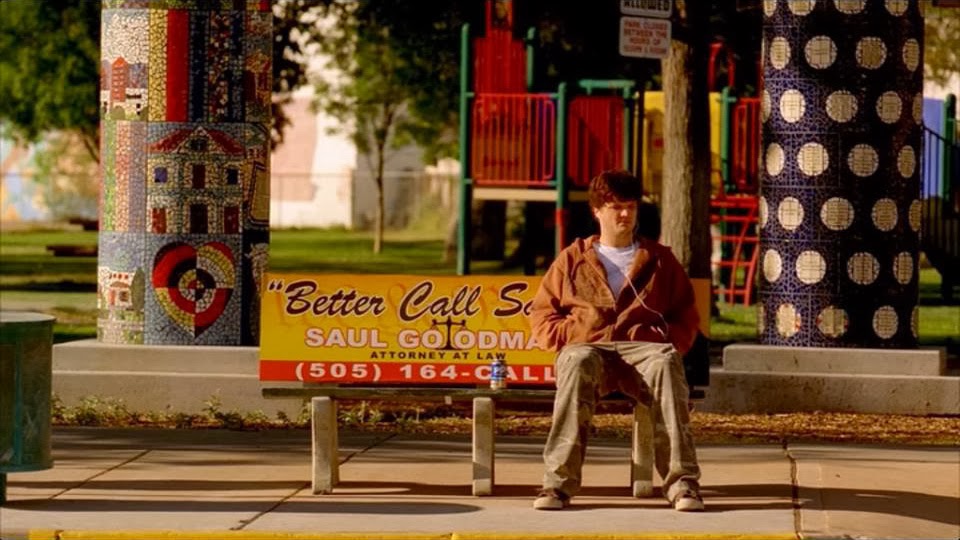
5. Better Call Saul (Season 2, Episode 8)
As a sign of the show’s many layers of greatness, Breaking Bad’s funniest episode is also one of its most cinematically ambitious. It opens with a single long shot of a lanky dude coercing Badger into selling him some meth. When that dude turns out to be a DEA agent and the deal a bust, you realize that long shot was probably a camera in a surveillance van across the street. Brilliant! The introduction of everyone’s favorite bus-stop lawyer, Saul Goodman, produces some of the series’ most memorable lines (“Faith and begorrah! A fellow potato eater!”) and leads to a criminal-for-hire taking the fall for Heisenberg — but only after everything goes wrong. It’s as rigorously edited a sequence as any meth-making or prison-shanking montage, and a million times more hilarious.

6. Crawl Space (Season 4, Episode 11)*
A single moment alone justifies this episode’s inclusion on any Top 10 list. In case you can’t remember the iconic moment to which we refer, here’s a refresher: Walter enters the crawl space for which this episode is named, expecting to find the money he needs to escape Gus Fring with the vacuum man. Instead, he finds an empty basement. Panicked, he begs Skylar to explain where the cash has gone, and she tells him, in a tone of measured terror, that she has given it to Ted. Walter, beginning to lose track of his sanity, breaks down. as the camera pans out, framing Walt in a coffin of his own misdeeds, he laughs maniacally. All the while, the sounds of mechanical feedback echo as the only sound in a void. There is only terror — then the credits roll.
Oh, and the rest of the episode works well, too.

7. Madrigal (Season 5, Episode 2)
Better than “Box Cutter”? “Dead Freight”? “Face Off”?! With its cocktail of tones, palettes and character moments, yes, “Madrigal” earns its rank. The cold open delivers a concentrated shot of delirium as a blank-eyed and silent German businessman taste-tests various condiments before committing suicide by automated external defibrillator. As a way to show the scope of Gus’ and Walt’s meth empire, the scene could not be more off-the-wall. From there, you get Jesse’s anguish over his “misplaced” ricin, Lydia’s horrifying pleas to Mike as he holds a gun to her head and Walt’s sickening bedroom abuse of Skyler. Good shows can live off dynamite set pieces and season finales, but only the greatest keep you riveted as the pieces are slowly put into place.

8. Face Off (Season 4, Episode 13)
First off, let us clarify that “Face Off” would be higher if not for the last scene’s Lily of the Valley reveal, which we buy but still consider a stretch. That being said … wow. Gus and Walt’s game of chess ends with a pawn, wheelchair-bound Tio Salamanca, taking out the mighty king. “Ding-BOOM,” read a card tacked onto the writers room’s board months before they wrote this episode, and we are grateful Gilligan and co. pulled all the stops to make it happen — even the ricin gambit, sure. But we most love Uncle Tio’s extended flip-off to the DEA, communicated one letter at a time, in order to lure Gus into Walt’s trap while ensuring he dies without becoming the most dreadful of creatures: a rat.

9. …And the Bag’s in the River (Season 1, Episode 3)*
Classic moments are scattered throughout this early episode, often marked by Breaking Bad aficionados — myself included — as the one that got them fixed on the series. Among these, two deserve “classic status” among the pantheon of great scenes. First, the cold open, where the camera switches off between Walt and Jesse struggling to choke back vomit as they clean the hydrochloric acid-soaked remains of Jesse’s former partner, and a younger Walt discussing the mysterious chemistry of the human body with Gretchen, then a fellow chemistry student. Second, a more simple, but equally powerful, scenario: Walter weighing the pros and cons of killing Krazy-8, a meth dealer who had previously attempted to kill him and Jesse.  The sole pro? “He’ll kill your entire family if you let him go.” In a single scene, Cranston and the writers manage to encapsulate Walter’s constant justification for his actions: he must protect his family, and it is better they than he. As the show goes on, of course, Walt bastardizes this logic, letting, “I did it for family!” justify increasingly heinous actions. In doing so, he becomes the danger.

10. Dead Freight (Season 5, Episode 5)*
Breaking Bad has it all, as the above list has attempted to illustrate. From slapstick humor to mortal terror — and everything in between — the show manages to pay homage to several forms of art while paving a strikingly original path. In “Dead Freight,” Gilligan and Co. take on the caper. In fact, in the vein of the Westerns they so love to reference, the writers have Walter and his team pull off a train robbery. Of course, they do not go in guns blazin’ — though the murder of Drew Sharp provides an exception. No, Walter is smarter than that. In one of the most captivating exploits of the series, they use ingenuity (science, bitch!) to pull off their bold plan. It is a fine example of Bad’s flexibility, and a thoroughly entertaining watch from start to finish.

Honorable Mentions: “Over” (Season 2, Episode 10), “Box Cutter” (Season 4, Episode 1), “Gliding Over All” (Season 5, Episode 8), “Half Measures” (Season 3, Episode 12), “To’hajiilee” (Season 5, Episode 13)

This article was originally written for The Cornell Daily Sun and can be viewed at its original location via this link.